
ARV Explained: How Lenders Size a Fix-and-Flip Loan
ARV explained: how lenders size a fix-and-flip loan from purchase plus rehab and after-repair value, with a worked example clearly labeled as an example.
ARV explained is how lenders size a fix-and-flip loan: they look at what the project costs and what the finished home should be worth, then take the tighter cap. A clear purchase price, rehab budget and supported after-repair value let a lender work through that math without extra back-and-forth. Requirements and terms vary by lender and by program, so this explainer describes how sizing commonly works, not the terms of any single program, and it is not a loan offer.
The Iron Hill Brief's guide to how lenders calculate after-repair value covers how comparable sales support the ARV number. This piece walks through how that figure, together with purchase plus rehab, sets a loan amount. Iron Hill's fix-and-flip loans page outlines the product.
ARV explained: how purchase plus rehab and after-repair value set the loan size
After-repair value, or ARV, is an estimate of what the property will be worth after the planned renovation is finished. It is not the purchase price and not the as-is value in the home's current condition.
Lenders commonly review three ratios together, as the Urban Institute describes in its April 2026 report on residential transition loans, the short-term business-purpose loans often used for flips. Loan-to-cost, or LTC, is based on the up-front acquisition cost plus the renovation budget — purchase plus rehab — and, the report says, can be up to 95 or 100 percent for a renovation. Loan-to-after-repaired-value, or LTARV, is based on the ARV and is usually no greater than 65 to 70 percent. Loan-to-as-is-value is usually no greater than 75 or 80 percent. The tightest cap sets the loan amount. Those ranges describe the sector, not a program Iron Hill offers.
A complete rehab budget matters because it is half of the cost figure. The Brief's report on building a fix-and-flip rehab budget covers how that scope is usually laid out.
A worked example, with made-up numbers
The figures in this section are an illustration only. They are made-up numbers, labeled as an example, and are not a quote, not program terms, and not leverage percentages Iron Hill offers.
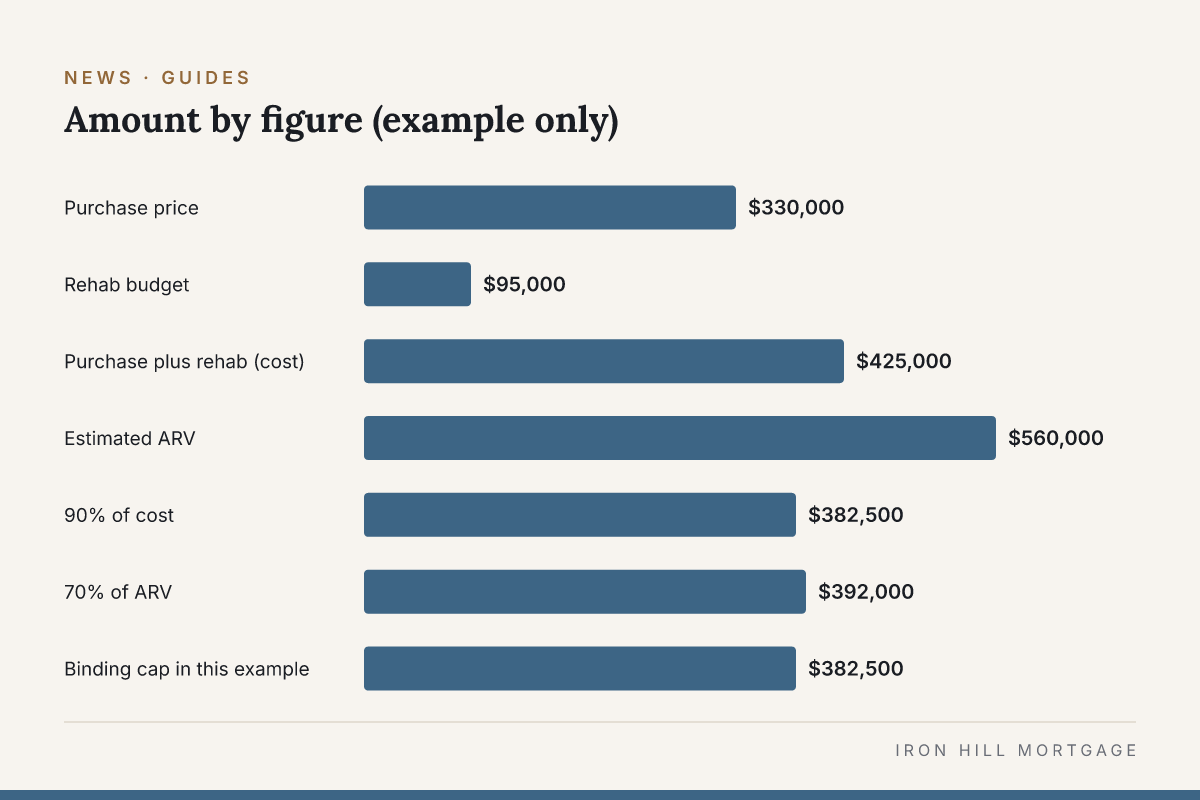
As an example, consider a house bought for $330,000 with a $95,000 renovation budget. Purchase plus rehab, the cost basis, is $425,000. The estimated ARV is $560,000.
| Figure (example only) | Amount |
|---|---|
| Purchase price | $330,000 |
| Rehab budget | $95,000 |
| Purchase plus rehab (cost) | $425,000 |
| Estimated ARV | $560,000 |
| 90% of cost | $382,500 |
| 70% of ARV | $392,000 |
| Binding cap in this example | $382,500 |
A 90% cap on cost, within the Urban Institute's loan-to-cost range, would allow $382,500. A 70% cap on after-repair value, at the top of the report's usual range, would allow $392,000. The tighter cost cap would set the loan at $382,500, and the investor would bring $42,500 plus closing and carrying costs. If the ARV cap were 65% instead, it would fall to $364,000 and become the tighter limit, and the investor would bring $61,000 plus those same extra costs. An as-is cap can also bind when the purchase price is close to current value.
What usually sits outside that loan size
The loan amount is not the full amount of cash a flip requires. Closing costs, interest reserves, taxes, insurance and utilities typically sit outside the cap, and a slipped rehab schedule can add to those carrying costs. Those items are part of the file a lender reviews, even when they are not advanced in the loan.
Frequently asked questions
How do lenders size a fix-and-flip loan using ARV?
They commonly compare a cap on purchase plus rehab (loan-to-cost) with a cap on after-repair value, and sometimes an as-is cap, and the tightest figure sets the loan amount. The ARV itself has to be supported; see the Brief's guide to how lenders calculate ARV.
What does purchase plus rehab mean in this sizing?
It is the cost basis used for loan-to-cost: the acquisition price plus the renovation budget. The Urban Institute describes that sum as the basis for the LTC ratio.
Are the dollar figures in this article a loan offer?
No. The worked example uses made-up numbers, clearly labeled as an example, to show the arithmetic. Actual caps, terms and cash required vary by lender, program and property.
Business-purpose loans for investment property only. Not for personal, family or household use. Subject to approval. Equal Housing Opportunity.
Sources
- Urban Institute, Stergios Theologides, "The Evolution of Residential Transition Lending," April 2026 (accessed Nov. 24, 2026): https://www.urban.org/sites/default/files/2026-04/Final_The_Evolution_of_Residential_Transition_Housing%20%281%29.pdf
Working on a rental, flip or other investment property? Text Ashley, our AI text assistant, at (615) 949-4780 or book a call (opens in a new tab). Iron Hill Mortgage NMLS #1946451 · Equal Housing Opportunity.