
Cap Rate vs. Cash-on-Cash Return: What Each Tells a Rental Investor
Cap rate vs. cash-on-cash return: one Middle Tennessee rental example shows what each ratio measures, how DSCR differs, and why a lender reads them apart.
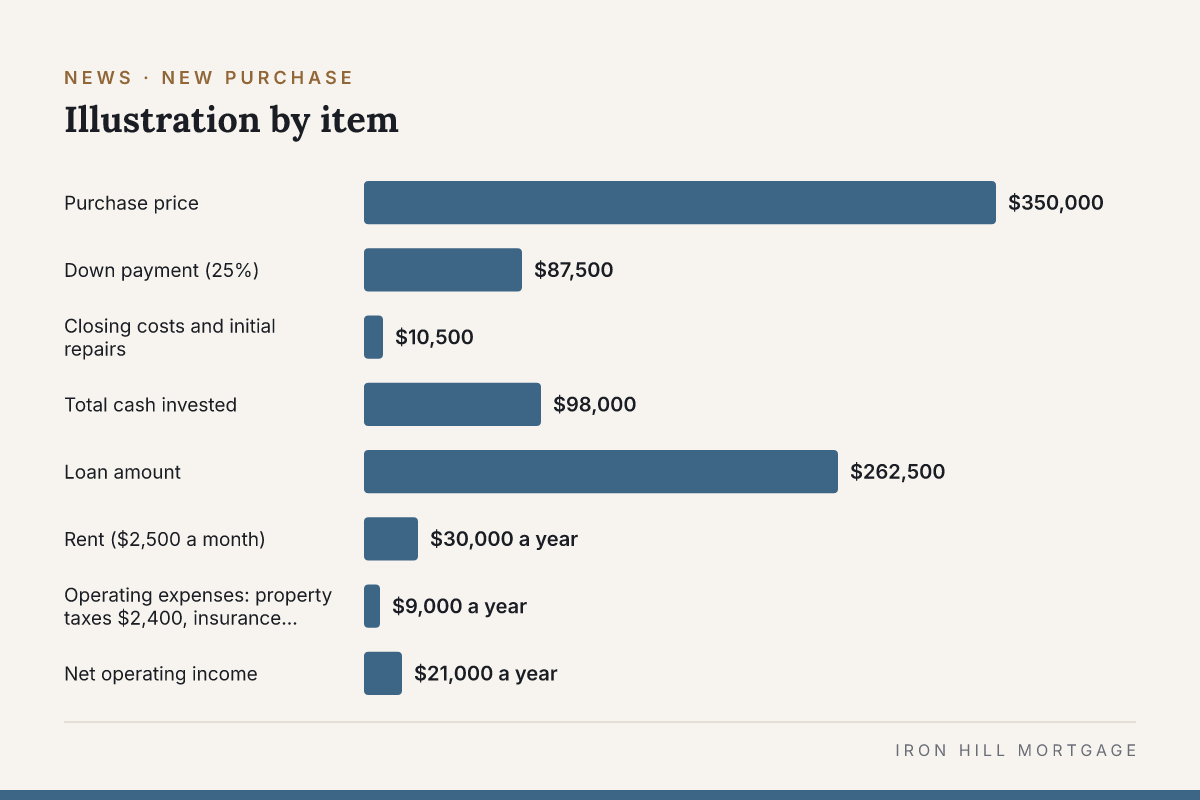
Cap rate vs. cash-on-cash return is one of the first comparisons a rental investor runs, and the two numbers answer different questions. The capitalization rate describes the property as if it were bought for cash. Cash-on-cash return describes the investor's own money after the loan payment. A lender looking at a rental file, meanwhile, often reads a third ratio, the debt service coverage ratio, or DSCR. The example below runs all three on one illustrative Middle Tennessee single-family rental.
What does a cap rate measure?
The Office of the Comptroller of the Currency, in its Comptroller's Handbook on commercial real estate lending, defines the capitalization rate as the ratio between a property's stabilized net operating income and its sales price. Net operating income, or NOI, is annual gross income less operating expenses. Because NOI is measured before any mortgage payment, the cap rate is the same whether the buyer pays cash or borrows. It is a way to compare properties with each other, not a measure of the investor's return on a financed purchase.
The handbook also notes that rising interest rates may lead to higher capitalization rates and lower property values without any change to the property's own fundamentals.
What does cash-on-cash return measure?
The CRE Finance Council's glossary defines cash-on-cash return as the annual cash flow received divided by the cash equity invested in a property, expressed as a percentage. In a financed purchase, that cash flow is what remains after the annual loan payment, and the cash invested is the down payment plus closing costs and any money spent on the property at the start. Because the loan payment sits inside the calculation, cash-on-cash return changes with the loan amount, the term and the payment, even when the property and its rent do not.
Cap rate vs. cash-on-cash return on one rental example
The figures below are an illustration only, not a Middle Tennessee rent or price quote, and the loan payment is an assumed figure, not a rate quote.
| Item | Illustration |
|---|---|
| Purchase price | $350,000 |
| Down payment (25%) | $87,500 |
| Closing costs and initial repairs | $10,500 |
| Total cash invested | $98,000 |
| Loan amount | $262,500 |
| Rent ($2,500 a month) | $30,000 a year |
| Operating expenses: property taxes $2,400, insurance $1,800, vacancy allowance $1,500, maintenance $1,500, management $1,800 | $9,000 a year |
| Net operating income | $21,000 a year |
| Assumed principal and interest ($1,650 a month) | $19,800 a year |
| Pre-tax cash flow after the loan payment | $1,200 a year |
On those numbers, the cap rate is $21,000 divided by $350,000, or 6.0%. The cash-on-cash return is $1,200 divided by $98,000, or about 1.2%. The same house produces a respectable-looking cap rate and a thin cash return, because most of the NOI goes to the loan payment.
The DSCR reads the same property from the lender's side. Most residential DSCR programs divide gross monthly rent by the qualifying monthly payment, which on a fully amortizing loan is PITIA: principal, interest, property taxes, insurance and any association dues. Here that is $1,650 plus $200 in taxes and $150 in insurance, or $2,000 a month, so the ratio is $2,500 divided by $2,000, or 1.25. The OCC handbook describes the commercial version, NOI divided by annual debt service, which on this example is $21,000 divided by $19,800, or about 1.06. Which version applies, and what minimum is required, varies by lender and program. The Iron Hill Brief's guide to DSCR loans in Tennessee covers that formula in more detail, and Iron Hill Mortgage's DSCR loan page explains how those loans qualify on the property's rent.
In short, the cap rate compares properties, cash-on-cash return measures the investor's cash yield after financing, and DSCR tells a lender whether the rent covers the payment. An investor building a larger position can also use the home equity calculator to see how much equity sits in a rental already owned.
Frequently asked questions
Is a higher cap rate always better?
Not on its own. A higher cap rate means more NOI per dollar of price, but it can also reflect a weaker location, an older building or less predictable rent. It also says nothing about the loan, so it should be read alongside cash-on-cash return and DSCR.
Why can cash-on-cash return be lower than the cap rate?
When the loan payment takes up most of the NOI, the cash left over is small relative to the cash invested. In the illustration, a 6.0% cap rate becomes about a 1.2% cash-on-cash return after a $19,800 annual loan payment.
Do lenders use cap rate or cash-on-cash return to approve a rental loan?
A residential DSCR lender generally focuses on the debt service coverage ratio, documented rent and the property's value rather than the investor's cash-on-cash return. Requirements vary by lender and program.
Working on a Tennessee rental? Talk with an Iron Hill loan advisor: text Ashley at 615-949-4780 or book a time here. Iron Hill Mortgage | NMLS #1946451.
Business-purpose loans for investment property only. Not for personal, family or household use. Subject to approval. Equal Housing Opportunity.
Sources
- Office of the Comptroller of the Currency, Comptroller's Handbook: Commercial Real Estate Lending, Version 2.0 (accessed Nov. 17, 2026): https://www.occ.gov/publications-and-resources/publications/comptrollers-handbook/files/commercial-real-estate-lending/pub-ch-commercial-real-estate.pdf
- CRE Finance Council, CREFC Glossary, "Cash-on-Cash Return" (accessed Nov. 17, 2026): https://www.crefc.org/cre/cre/content/learn/Glossary/CREFC_Glossary.aspx?GlossaryTabs=3