
Credit Score Needed for a Mortgage: FHA, VA and Conventional Rules
The credit score needed for a mortgage varies by loan type. FHA, Fannie Mae and VA rules, which score lenders use and how scores change the cost of a loan.
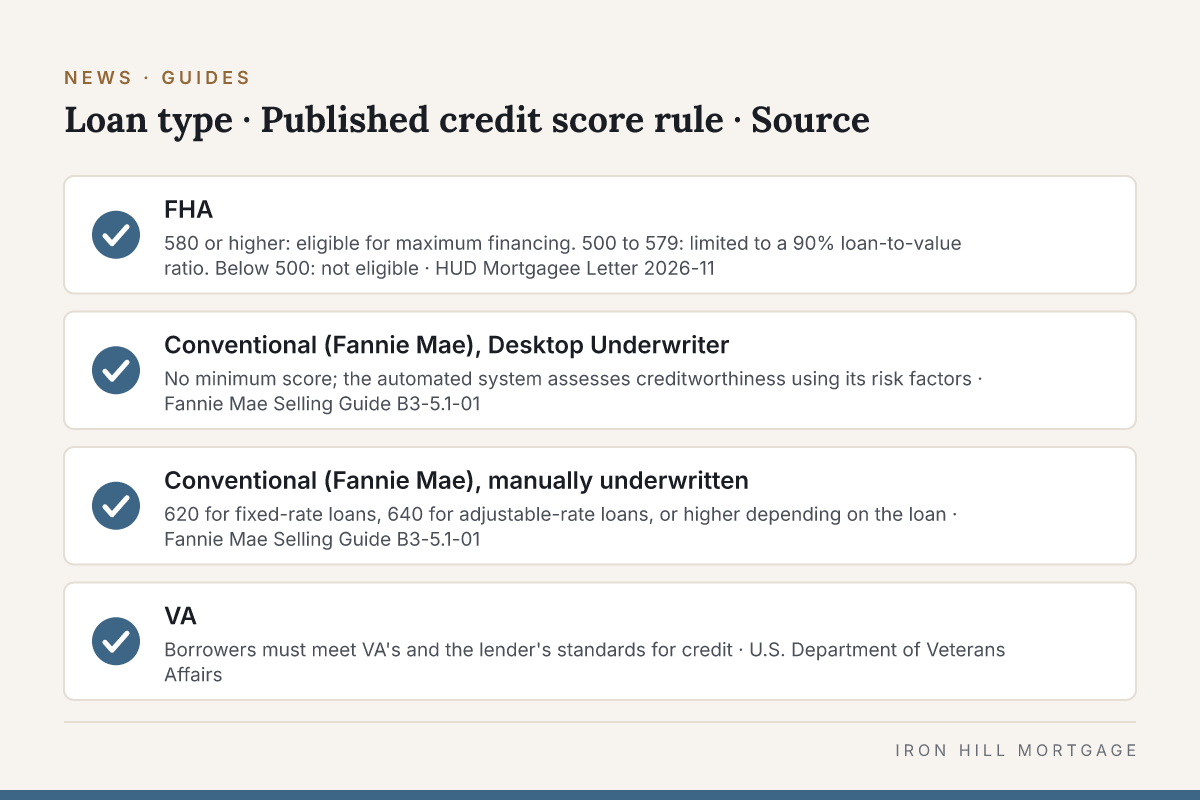
The credit score needed for a mortgage depends on the loan type: FHA sets a floor of 500, Fannie Mae sets 620 for manually underwritten fixed-rate loans, and the VA leaves the standard to its own rules and the lender's. Beyond those minimums, the score also shapes what a borrower pays, because lenders and the agencies that buy or insure loans price risk by credit score.
This guide covers the published minimums for the main loan types, how lenders pick the score they use, and why a higher score can lower the cost of a loan.
Credit score needed for a mortgage, by loan type
| Loan type | Published credit score rule | Source |
|---|---|---|
| FHA | 580 or higher: eligible for maximum financing. 500 to 579: limited to a 90% loan-to-value ratio. Below 500: not eligible | HUD Mortgagee Letter 2026-11 |
| Conventional (Fannie Mae), Desktop Underwriter | No minimum score; the automated system assesses creditworthiness using its risk factors | Fannie Mae Selling Guide B3-5.1-01 |
| Conventional (Fannie Mae), manually underwritten | 620 for fixed-rate loans, 640 for adjustable-rate loans, or higher depending on the loan | Fannie Mae Selling Guide B3-5.1-01 |
| VA | Borrowers must meet VA's and the lender's standards for credit | U.S. Department of Veterans Affairs |
Sources: HUD; Fannie Mae; U.S. Department of Veterans Affairs.
For FHA loans, a 90% loan-to-value limit means a buyer with a score from 500 to 579 needs to put down at least 10% of the home's value. Fannie Mae's manual-underwriting minimums can be higher than 620 or 640, because its Eligibility Matrix sets them by credit score, loan-to-value ratio, loan purpose, number of units and debt-to-income ratio. Jumbo and other loans outside these programs set their own score requirements, which vary by lender.
Lenders can also add requirements of their own on top of agency rules, so meeting a published minimum does not by itself mean a loan will be approved.
Which credit score does a lender use?
The Consumer Financial Protection Bureau notes that a borrower does not have just one credit score; scores vary by scoring model, data source and the day they are calculated. Most range from 300 to 850.
FHA's rule shows how lenders narrow that down. For each borrower, HUD says the lender uses the middle score when three differing scores are reported, the lower one when there are two and the only score when there is one. The minimum decision credit score is the lowest of those borrower-level scores among everyone on the loan.
Mortgagee Letter 2026-11, dated Oct. 8, 2026, lets FHA lenders use FICO 10T and VantageScore 4.0 alongside Classic FICO for case numbers assigned on or after Jan. 1, 2027. HUD says it will still require a three-bureau credit report and that the minimum score thresholds stay the same regardless of the model used. Fannie Mae's Selling Guide likewise says it is moving to newer score models, while Classic FICO versions remain required for now.
How does a credit score affect the cost of a mortgage?
The CFPB says lenders use credit scores to decide whether to offer a loan and to set the interest rate. A higher score usually makes it easier to qualify and may bring a better rate or terms.
Fannie Mae's Loan-Level Price Adjustment Matrix shows the effect on conventional loans. For a home purchase with a term longer than 15 years and a loan-to-value ratio between 75.01% and 80%, the matrix lists these upfront adjustments as a percentage of the loan amount:
| Credit score | Adjustment |
|---|---|
| 780 or higher | 0.375% |
| 740 to 759 | 0.875% |
| 700 to 719 | 1.375% |
| 660 to 679 | 1.875% |
| 639 or lower | 2.750% |
Source: Fannie Mae Loan-Level Price Adjustment Matrix, dated Sept. 30, 2026, purchase-money loans. Selected score ranges shown.
The Federal Housing Finance Agency says lenders typically pass an upfront fee like this through to the borrower as a slightly higher interest rate. Score is one input; Iron Hill Brief's guide to the debt-to-income ratio covers another, and its explainer on preapproval vs. prequalification explains when a lender pulls credit. The home affordability calculator can help set a price range.
Frequently asked questions
What is the lowest credit score for an FHA loan? HUD sets the floor at 500. Borrowers with scores from 500 to 579 are limited to a 90% loan-to-value ratio, and those at 580 or above are eligible for maximum financing.
Does Fannie Mae require a 620 credit score? For manually underwritten fixed-rate loans, yes, and 640 for adjustable-rate loans. Fannie Mae's Selling Guide says loans underwritten through its Desktop Underwriter system have no minimum score.
Does the VA set a minimum credit score? The VA says borrowers must meet both VA's and the lender's credit standards, so the score a lender requires can differ from one lender to another.
Sources
- Fannie Mae, Selling Guide B3-5.1-01, "General Requirements for Credit Scores" (04/22/2026; accessed Oct. 28, 2026): https://selling-guide.fanniemae.com/sel/b3-5.1-01/general-requirements-credit-scores
- U.S. Department of Housing and Urban Development, Mortgagee Letter 2026-11, "Updated Minimum Decision Credit Score Methodology for the Implementation of Alternative Credit Scores," Oct. 8, 2026: https://www.hud.gov/sites/default/files/hudclips/documents/2026-11hsgml.pdf
- U.S. Department of Veterans Affairs, "Purchase loan" (accessed Oct. 28, 2026): https://www.va.gov/housing-assistance/home-loans/loan-types/purchase-loan/
- Consumer Financial Protection Bureau, "What is a credit score?" (last reviewed Sept. 2, 2026): https://www.consumerfinance.gov/ask-cfpb/what-is-a-credit-score-en-315/
- Fannie Mae, Loan-Level Price Adjustment Matrix, dated Sept. 30, 2026 (accessed Oct. 28, 2026): https://singlefamily.fanniemae.com/media/9391/display
- Fannie Mae, Eligibility Matrix, dated Aug. 5, 2026 (accessed Oct. 28, 2026): https://singlefamily.fanniemae.com/media/20786/display
- Federal Housing Finance Agency, "Guarantee Fees History" (accessed Oct. 28, 2026): https://www.fhfa.gov/policy/guarantee-fees