
Owner's Title Insurance: How It Differs From the Lender's Policy at Closing
Owner's title insurance explained: what it covers, how it differs from the lender's policy, how both appear on your Loan Estimate and how to shop for them.
Owner's title insurance is a separate, usually optional policy that protects a homebuyer's own stake in a property against legal claims tied to its past, and it is often confused with the lender's title policy most borrowers are required to buy. The Consumer Financial Protection Bureau describes both policies, and federal disclosure rules set out how each appears on a buyer's loan paperwork.
This guide explains what each policy covers, how they show up on the Loan Estimate and Closing Disclosure, and what federal rules say about shopping for title insurance.
What does owner's title insurance cover, and how is the lender's policy different?
When a buyer purchases a home, they receive a document, usually called a deed, showing that the seller transferred legal ownership, or title, to them. According to the CFPB, title insurance can protect the buyer if someone later sues and says they have a claim against the home from before the purchase. The bureau gives two examples: a previous owner's failure to pay taxes, and contractors who say they were not paid for work done on the home before the sale.
The CFPB says most lenders require borrowers to buy a lender's title insurance policy, which protects the amount the lender lends. An owner's policy is a separate purchase that can help protect the buyer's own financial investment in the home.
Lender's title insurance protects only the lender. The CFPB says it does not protect the homeowner's investment in the home, or equity, and that if someone sues with a claim against the home, the homeowner is the first person responsible. The lender's policy covers only claims that affect the lender's loan.
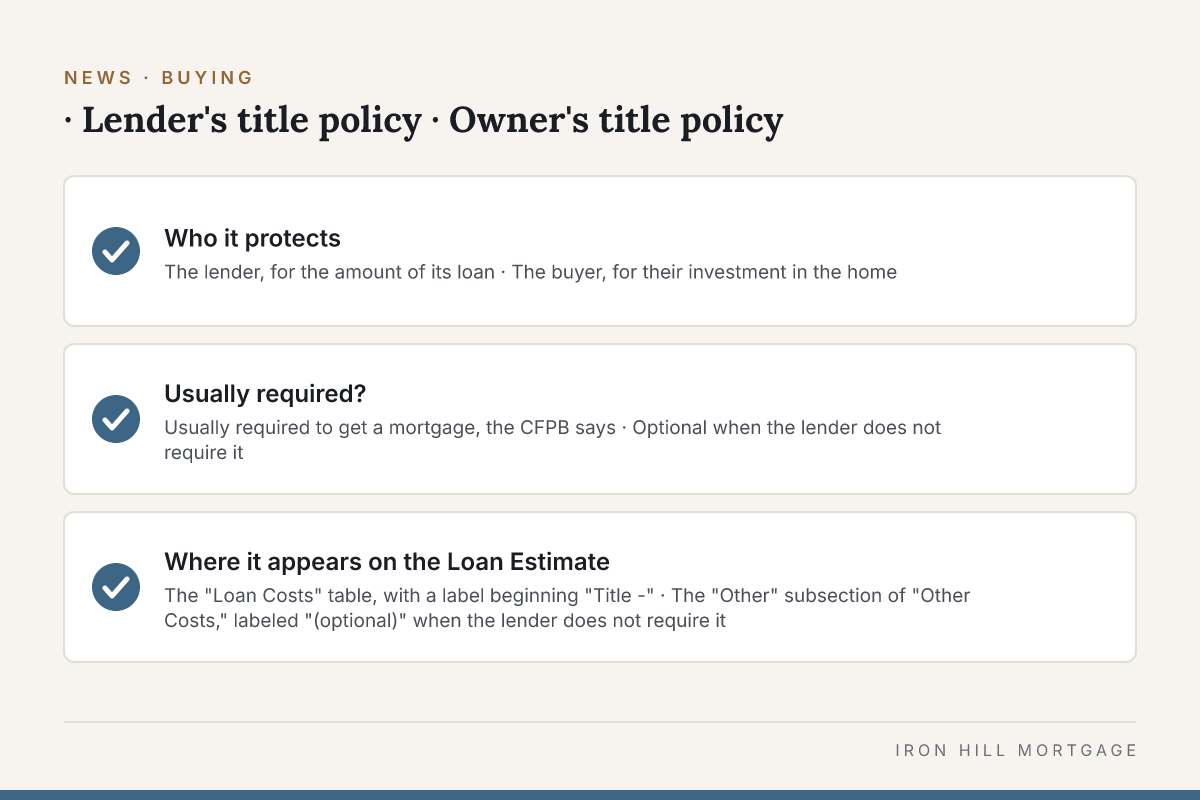
| Lender's title policy | Owner's title policy | |
|---|---|---|
| Who it protects | The lender, for the amount of its loan | The buyer, for their investment in the home |
| Usually required? | Usually required to get a mortgage, the CFPB says | Optional when the lender does not require it |
| Where it appears on the Loan Estimate | The "Loan Costs" table, with a label beginning "Title -" | The "Other" subsection of "Other Costs," labeled "(optional)" when the lender does not require it |
Sources: Consumer Financial Protection Bureau; Regulation Z, 12 CFR 1026.37 and official interpretations.
How does title insurance appear on the Loan Estimate?
Under Regulation Z, every charge that is a component of title insurance or is for conducting the closing must carry a label beginning with "Title -" on the Loan Estimate. The lender's policy is disclosed in the "Loan Costs" table at the full premium rate, without any discount that might apply when an owner's policy is bought at the same time.
An owner's policy that the lender does not require is listed in the "Other" subsection of the form's "Other Costs" table, with a label such as "Title - Owner's Title Policy (optional)." When a discounted rate is available for buying both policies together, the rule has the owner's premium shown as the full owner's premium, plus the discounted premium for the lender's coverage, minus the full premium for the lender's coverage. As a result, the owner's line on the form can differ from the premium a title company quotes for the owner's policy alone.
The CFPB adds that, depending on the state, the settlement agent, lawyer, lender, real estate agent or title company may give the buyer an itemized list of title fees at closing that looks different from the Loan Estimate or Closing Disclosure. That does not necessarily mean the buyer is being charged more. The bureau says the title-related costs on that list should add up to the total of the title-related costs on the loan forms, and that buyers comparing title insurance costs should compare the bottom-line total. Iron Hill Brief's guide to the Closing Disclosure covers the final review of those figures before closing.
Can buyers shop for title insurance?
The CFPB says buyers can usually shop for a title insurance provider separately from their mortgage, and that shopping could save money. If a buyer chooses to purchase an owner's policy, the bureau says the total cost is usually lower when the same provider issues both the lender's and the owner's policy than when they are bought separately.
A seller also cannot dictate the choice. Under the Real Estate Settlement Procedures Act, the CFPB says, a seller may not require a buyer, directly or indirectly, to purchase title insurance from any particular company as a condition of the sale.
Title charges are one part of a buyer's closing costs. Iron Hill Brief's explainer on what mortgage closing costs include covers the rest, and the home affordability calculator can help a buyer set a price range before making an offer.
Frequently asked questions
Is owner's title insurance required? The CFPB says most lenders require a lender's title policy, while an owner's policy is something a buyer may want to purchase to protect their own investment. When the lender does not require it, the Loan Estimate labels the owner's policy "(optional)."
Does the lender's title policy protect the homeowner? No. According to the CFPB, the lender's policy covers only claims that affect the lender's loan and does not protect the homeowner's equity.
Why does the title insurance amount on my Loan Estimate differ from the title company's paperwork? The CFPB says state-required itemized fee lists can display the same charges differently. The total of all title-related costs should match the title-related totals on the Loan Estimate or Closing Disclosure.
Sources
- Consumer Financial Protection Bureau, "What is owner's title insurance?" (last reviewed Oct. 19, 2023): https://www.consumerfinance.gov/ask-cfpb/what-is-owners-title-insurance-en-164/
- Consumer Financial Protection Bureau, "What is lender's title insurance?" (last reviewed Sept. 11, 2024): https://www.consumerfinance.gov/ask-cfpb/what-is-lenders-title-insurance-en-163/
- Consumer Financial Protection Bureau, "Why is the title insurance premium on the Loan Estimate and Closing Disclosure different from the premium listed on the paperwork I received from the title insurance company? Am I being charged more?" (last reviewed Aug. 9, 2024): https://www.consumerfinance.gov/ask-cfpb/why-is-the-title-insurance-premium-on-the-loan-estimate-and-closing-disclosure-different-from-the-premium-listed-on-the-paperwork-i-received-from-the-title-insurance-company-am-i-being-charged-more-en-1993/
- Consumer Financial Protection Bureau, "The seller told me I have to purchase title insurance from a particular company or they won't sell me the house. Can they do this?" (last reviewed Sept. 11, 2024): https://www.consumerfinance.gov/ask-cfpb/the-seller-told-me-i-have-to-purchase-title-insurance-from-a-particular-company-or-they-won146t-sell-me-the-house-can-they-do-this-en-158/
- Consumer Financial Protection Bureau, Regulation Z, 12 CFR 1026.37, Content of disclosures for certain mortgage transactions (Loan Estimate), with official interpretations: https://www.consumerfinance.gov/rules-policy/regulations/1026/37/