
Assumable Mortgage: How FHA and VA Loan Assumptions Work
An assumable mortgage lets a buyer take over a seller's FHA or VA loan. Who can assume one, how the seller is released from the debt and what VA charges.
An assumable mortgage lets a home buyer take over the seller's existing loan, including its balance, interest rate and remaining term, instead of getting a new mortgage. FHA-insured and VA-backed loans can be assumed under federal rules, but the buyer generally has to qualify, and the seller stays on the hook unless the lender formally releases them.
How an FHA assumable mortgage works
For FHA-insured mortgages closed on or after Dec. 15, 1989, HUD says it will direct the lender to call the loan due if the home is sold or transferred to someone who will not live in it as a principal residence or whose credit has not been approved under HUD's requirements. In practice, that means an FHA loan can generally be assumed only by a creditworthy buyer who will occupy the home, not by an investor.
Even when an approved buyer assumes the loan, HUD says the original homeowner remains liable for the debt unless the lender releases them. Lenders are instructed to prepare that release, form HUD-92210.1, Approval of Purchaser and Release of Seller, when the seller sells to a creditworthy owner-occupant who signs an agreement to assume the debt.
How a VA assumable mortgage works
VA rules require a loan assumption to be approved if the loan is current, the buyer is contractually obligated to buy the home and take on full liability, and the buyer is creditworthy under VA's standards, according to VA Circular 26-23-10. Loan holders with automatic authority must decide on a complete application within 45 calendar days, and a disapproval can be appealed to VA within 30 days.
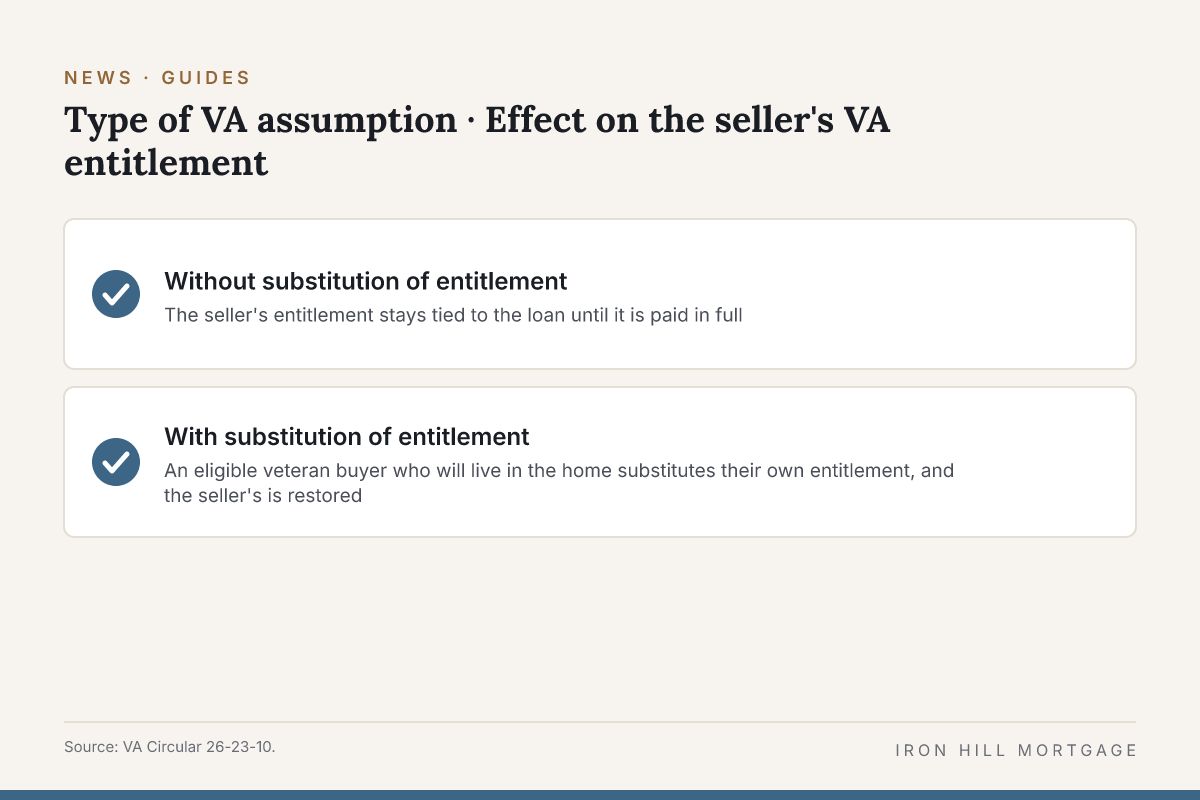
The buyer does not have to be a veteran, but that choice affects the seller's VA benefit:
| Type of VA assumption | Effect on the seller's VA entitlement |
|---|---|
| Without substitution of entitlement | The seller's entitlement stays tied to the loan until it is paid in full |
| With substitution of entitlement | An eligible veteran buyer who will live in the home substitutes their own entitlement, and the seller's is restored |
Source: VA Circular 26-23-10.
VA lists a funding fee of 0.5% for loan assumptions on its funding fee page, and it calculates funding fees as a percentage of the loan amount.
What an assumable mortgage does not cover
An assumption transfers only the existing loan balance. If the home's price is higher than what is left on the mortgage, the buyer has to cover the difference at closing with cash or separate financing, and that gap can be large on a loan that has been paid down for years or on a home that has gained value.
Buyers weighing an assumption alongside a new loan can compare the full monthly cost, including mortgage insurance. The Iron Hill Brief's guide to how FHA mortgage insurance works explains the premiums that can come with an FHA loan, its explainer on the VA IRRRL covers refinancing a VA loan later, and its guide to the Closing Disclosure three-day rule covers the final review before closing.
Frequently asked questions
Can anyone assume an FHA loan? Not under HUD's rules for loans closed on or after Dec. 15, 1989. The buyer's credit must be approved, and the buyer must occupy the home as a principal residence or HUD-approved secondary residence, with limited exceptions HUD lists.
Does the seller stay liable after an assumption? Yes, unless the lender releases them. FHA sellers should ask for form HUD-92210.1, and VA assumptions involve a release of liability as part of the transfer.
Do you have to be a veteran to assume a VA loan? No. A buyer who is creditworthy under VA standards can assume the loan, but only an eligible veteran who will occupy the home can substitute entitlement so the seller's VA benefit is restored.
Sources
- U.S. Department of Housing and Urban Development, "Notice to Homeowner: Release of Personal Liability for Assumptions of Mortgages Closed On or After December 15, 1989" (accessed Oct. 30, 2026): https://www.hud.gov/sites/documents/sfhhorelperliabassum.pdf
- U.S. Department of Veterans Affairs, Veterans Benefits Administration Circular 26-23-10, "VA Assumption Updates" (May 22, 2023; accessed Oct. 30, 2026): https://www.benefits.va.gov/HOMELOANS/documents/circulars/26-23-10.pdf
- U.S. Department of Veterans Affairs, "VA funding fee and loan closing costs" (last updated Oct. 5, 2026; accessed Oct. 30, 2026): https://www.va.gov/housing-assistance/home-loans/funding-fee-and-closing-costs/