
Duplex Loan Tennessee: Financing a 2-4 Unit as Investor or Owner
A duplex loan in Tennessee can finance a 2-4 unit as an investment or owner-occupied home, with different LTV caps, reserves, and how rent is counted.
A duplex loan in Tennessee can finance a two-, three- or four-unit residential property either as an investment or as an owner-occupied home, and the occupancy choice changes how Fannie Mae treats loan-to-value limits, reserves and rental income. Duplexes and fourplexes remain within Fannie Mae's one-to-four-unit residential property rules, so they can be delivered as conventional loans when the rest of the file meets the Selling Guide.
How a duplex loan in Tennessee is classified
Fannie Mae purchases first-lien mortgages on residential properties of one to four units, according to Selling Guide B2-3-01. A duplex, triplex or fourplex that no borrower occupies as a principal residence or second home is an investment property under B2-1.1-01. If at least one borrower occupies one of the units as a principal residence, the loan is treated as a principal-residence transaction on a two- to four-unit property.
That classification matters for pricing and for the Eligibility Matrix. Investment-property loans carry a loan-level price adjustment, and multiple-unit properties can carry an additional property-type adjustment. Investment-property loans delivered to Fannie Mae must be underwritten through Desktop Underwriter and receive an Approve/Eligible recommendation, with limited exceptions noted in the Selling Guide.
Loan-to-value and reserve differences
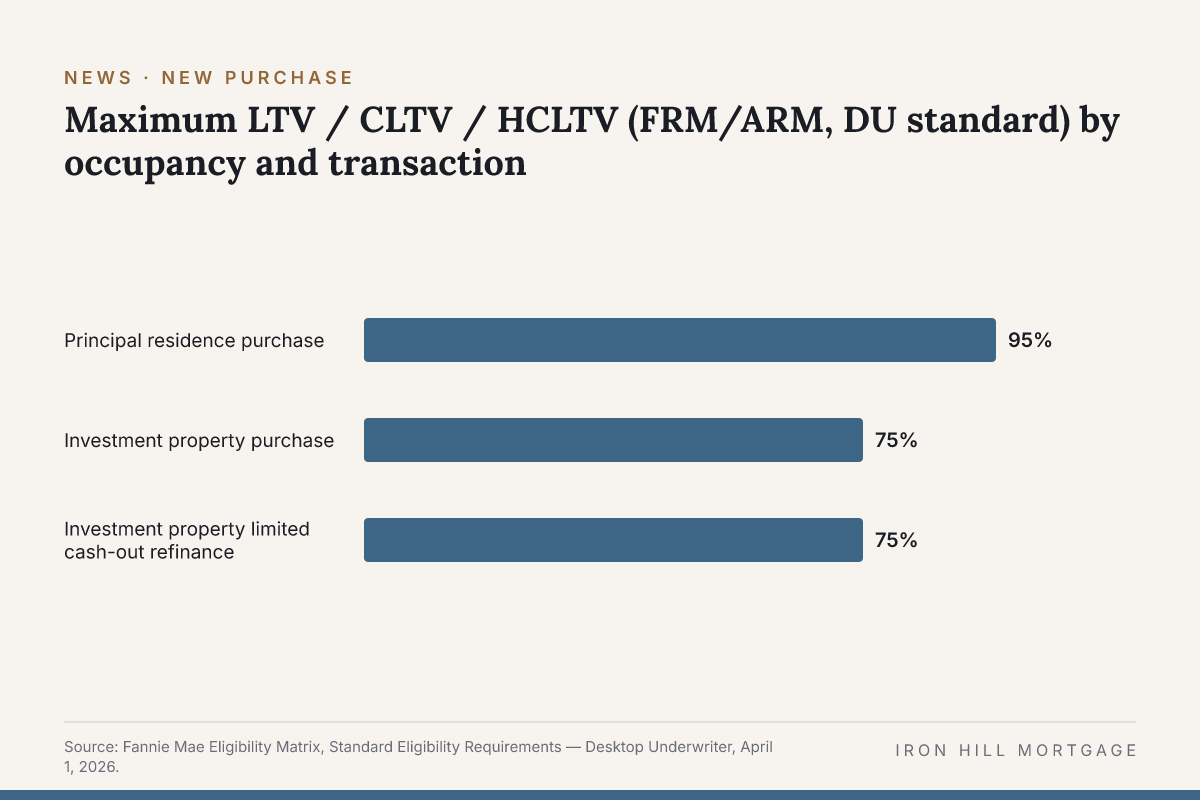
Fannie Mae's Eligibility Matrix (April 1, 2026) sets different maximum loan-to-value ratios by occupancy and unit count for Desktop Underwriter loans:
| Occupancy and transaction | Units | Maximum LTV / CLTV / HCLTV (FRM/ARM, DU standard) |
|---|---|---|
| Principal residence purchase | 2–4 | 95% |
| Investment property purchase | 1–4 | 75% |
| Investment property limited cash-out refinance | 1–4 | 75% |
Source: Fannie Mae Eligibility Matrix, Standard Eligibility Requirements — Desktop Underwriter, April 1, 2026.
Reserve requirements also differ. For Desktop Underwriter casefiles, Selling Guide B3-4.1-01 says the system generally requires six months of reserves for a two- to four-unit principal residence and for an investment property. Additional reserves apply when the borrower already owns other financed properties and the subject loan is a second home or investment property.
How rent from the other units is counted
On a two- to four-unit principal residence, rental income from the units the borrower does not occupy may be eligible to qualify if the income is likely to continue, under Selling Guide B3-3.8-01. Positive rental income can be used as qualifying income only when the borrower has at least 12 months of property management experience; with less experience, qualifying rental income may only offset the property's PITIA. For investment properties, rental income treatment follows the same chapter, and lenders must report monthly gross rent on delivery for two- to four-unit principal residences and all investment properties.
Business-purpose rental-income loans, such as DSCR loans, are not Fannie Mae products and set their own occupancy, seasoning and rent tests. Investors comparing small multifamily options can also read the Brief's report on Nashville multifamily permits. The home equity calculator can help estimate equity in a property an investor already owns.
Working on a Tennessee rental? Talk with an Iron Hill loan advisor: text Ashley at 615-949-4780 or book a time here. Iron Hill Mortgage | NMLS #1946451.
Business-purpose loans for investment property only. Not for personal, family or household use. Subject to approval. Equal Housing Opportunity.
Sources
- Fannie Mae Selling Guide, B2-1.1-01, "Occupancy Types" (accessed Nov. 6, 2026): https://selling-guide.fanniemae.com/sel/b2-1.1-01/occupancy-types
- Fannie Mae Selling Guide, B2-3-01, "General Property Eligibility" (accessed Nov. 6, 2026): https://selling-guide.fanniemae.com/sel/b2-3-01/general-property-eligibility
- Fannie Mae Selling Guide, B3-4.1-01, "Minimum Reserve Requirements" (accessed Nov. 6, 2026): https://selling-guide.fanniemae.com/sel/b3-4.1-01/minimum-reserve-requirements
- Fannie Mae Selling Guide, B3-3.8-01, "General Rental Income Information" (accessed Nov. 6, 2026): https://selling-guide.fanniemae.com/sel/b3-3.1-08/rental-income
- Fannie Mae Eligibility Matrix (April 1, 2026; accessed Nov. 6, 2026): https://singlefamily.fanniemae.com/media/47926/display