
FHA to Conventional Refinance: How It Can End Mortgage Insurance
An FHA to conventional refinance can end FHA mortgage insurance. How long FHA premiums last, how private mortgage insurance differs and what to weigh.
An FHA to conventional refinance replaces a Federal Housing Administration loan with a conventional mortgage, and for many FHA borrowers who plan to keep their home it is the main way to stop paying FHA's annual mortgage insurance premium before the end of the loan's term. Whether the switch saves money depends on the home's current value, the borrower's credit and the costs of the new loan.
This guide explains how long FHA insurance lasts, how private mortgage insurance on a conventional loan differs, and what to weigh before refinancing.
How long does FHA mortgage insurance last?
FHA loans carry two premiums: an upfront premium paid at closing or financed into the loan, and an annual premium billed monthly. Under the schedule in HUD's Mortgagee Letter 2023-05, the annual premium on a loan with a term longer than 15 years runs for 11 years if the loan-to-value ratio at origination was 90% or less. If it was above 90%, the premium runs for the life of the mortgage.
HUD says that for FHA cases assigned on or after June 3, 2013, the insurance can be terminated when the mortgage is paid in full before its maturity date. For a borrower who put down less than 10%, that means a sale or a refinance is what ends the premium. Iron Hill Brief's explainer on how FHA mortgage insurance works covers the premium schedule in detail.
How does conventional mortgage insurance differ?
The Consumer Financial Protection Bureau says borrowers who put down less than 20% typically pay mortgage insurance on a conventional loan as well. The difference is how it is priced and when it ends.
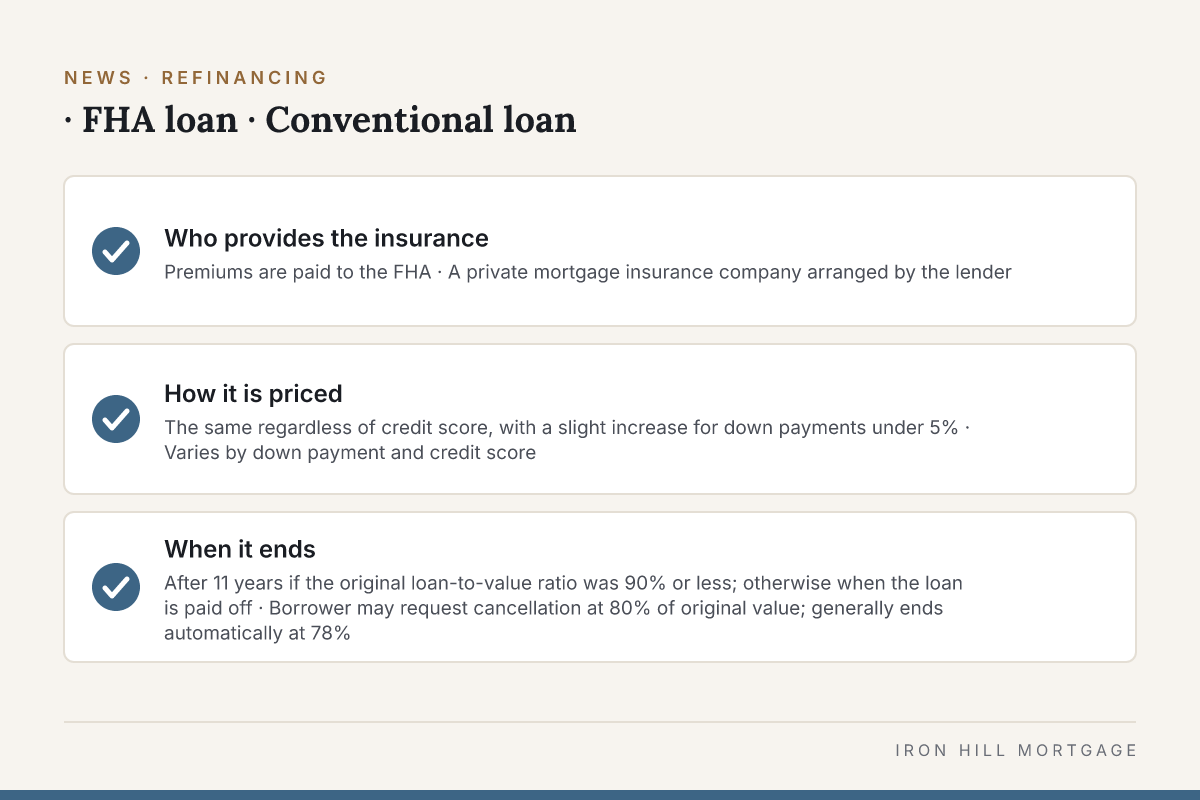
| FHA loan | Conventional loan | |
|---|---|---|
| Who provides the insurance | Premiums are paid to the FHA | A private mortgage insurance company arranged by the lender |
| How it is priced | The same regardless of credit score, with a slight increase for down payments under 5% | Varies by down payment and credit score |
| When it ends | After 11 years if the original loan-to-value ratio was 90% or less; otherwise when the loan is paid off | Borrower may request cancellation at 80% of original value; generally ends automatically at 78% |
Sources: HUD Mortgagee Letter 2023-05 and HUD premium guidance; Consumer Financial Protection Bureau.
The CFPB says private mortgage insurance is generally cheaper than FHA insurance for borrowers with good credit. Under federal rules for single-family principal residences that closed on or after July 29, 1999, borrowers can ask the servicer to cancel it once the balance is scheduled to reach 80% of the home's original value, and the servicer generally must end it automatically at 78%. For a refinanced loan, the CFPB says "original value" means the appraised value at the time of the refinance.
That last point matters for an FHA borrower whose home has gained value. If the new appraisal supports a loan of 80% of the value or less, a conventional loan typically would not need mortgage insurance at all.
What to weigh before an FHA to conventional refinance
A refinance is a new loan with its own closing costs, and the rate on the new loan may be higher or lower than the rate on the FHA loan. A borrower who gives up a lower FHA rate to drop the premium could pay more each month, not less.
Conventional pricing also depends on credit. Fannie Mae's Loan-Level Price Adjustment Matrix sets upfront charges on refinances that do not take cash out based on credit score and loan-to-value ratio, and the charges rise as scores fall. A borrower whose credit has improved since the FHA loan closed may see better conventional pricing than one whose score has dropped.
Comparing the monthly savings with the total cost of the new loan shows how long it would take to break even. Iron Hill Brief's guide to the no-closing-cost refinance walks through that trade-off, and its look at the FHA streamline refinance covers the option of staying in the FHA program. The exact costs for a specific loan appear on the Loan Estimate.
Frequently asked questions
Can I remove FHA mortgage insurance without refinancing? If the original loan-to-value ratio was 90% or less, the annual premium ends after 11 years under HUD's current premium schedule. For loans above 90%, HUD's guidance says the insurance ends when the mortgage is paid in full, which in practice means a sale or a refinance.
Does the new loan have to be 80% of the home's value or less? Not necessarily, but a conventional loan above 80% of the home's value typically carries private mortgage insurance. The CFPB says that coverage can be canceled later under federal rules.
Does my credit score matter for an FHA to conventional refinance? Yes. Private mortgage insurance and Fannie Mae's upfront pricing both vary by credit score, while FHA insurance does not.
Sources
- U.S. Department of Housing and Urban Development, Mortgagee Letter 2023-05, "Reduction of Federal Housing Administration (FHA) Annual Mortgage Insurance Premium (MIP) Rates" (accessed Oct. 28, 2026): https://www.hud.gov/sites/dfiles/OCHCO/documents/2023-05hsgml.pdf
- U.S. Department of Housing and Urban Development, Single Family Mortgage Insurance Premiums, "Discontinuing Monthly Mortgage Insurance Premium Payments" (accessed Oct. 28, 2026): https://www.hud.gov/hud-partners/housing-mip
- Consumer Financial Protection Bureau, "When can I remove private mortgage insurance (PMI) from my loan?" (last reviewed Aug. 28, 2026): https://www.consumerfinance.gov/ask-cfpb/when-can-i-remove-private-mortgage-insurance-pmi-from-my-loan-en-202/
- Consumer Financial Protection Bureau, "What is mortgage insurance and how does it work?" (last reviewed Aug. 28, 2026): https://www.consumerfinance.gov/ask-cfpb/what-is-mortgage-insurance-and-how-does-it-work-en-1953/
- Fannie Mae, Loan-Level Price Adjustment Matrix, dated Sept. 30, 2026 (accessed Oct. 28, 2026): https://singlefamily.fanniemae.com/media/9391/display