
Landlord Insurance in Tennessee: What Rental Properties Need
Landlord insurance in Tennessee covers the rental building, not a tenant's belongings. How dwelling coverage differs from homeowners and why lenders ask.
Landlord insurance in Tennessee is the coverage investors buy for a rental dwelling, and it is not the same product a homeowner buys for a house they live in. The Tennessee Department of Commerce and Insurance tells consumers that a landlord's insurance protects the building, not a tenant's personal property — a distinction that also matters to lenders reviewing a rental file.
Landlord insurance vs. homeowners insurance
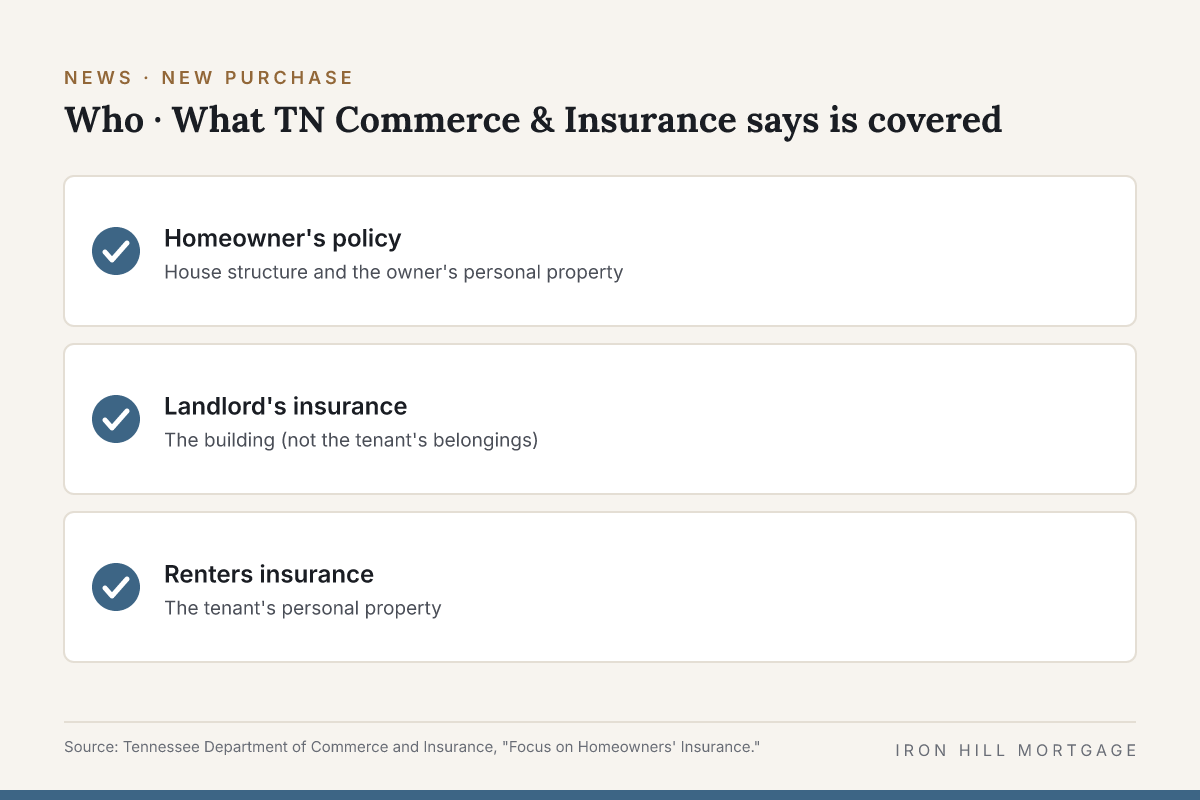
The Department's Focus on Homeowners' Insurance page draws a clear line. Homeowners insurance typically protects the structure and the owner's personal property. Renters insurance protects a tenant's belongings. Landlord insurance — often written as a dwelling or landlord policy — is aimed at the building and the landlord's liability related to the rental, not the tenant's sofa or electronics.
| Who | What TN Commerce & Insurance says is covered |
|---|---|
| Homeowner's policy | House structure and the owner's personal property |
| Landlord's insurance | The building (not the tenant's belongings) |
| Renters insurance | The tenant's personal property |
Source: Tennessee Department of Commerce and Insurance, "Focus on Homeowners' Insurance."
The same page notes that everyone — owners and renters — needs liability protection for accidents that injure others or damage their property, and that flood damage is not included in a standard homeowners policy. Those cautions apply equally when an investor shops a landlord policy: ask what perils are covered, whether loss-of-rents or business-liability endorsements are available, and whether short-term or mid-term rental use is excluded.
This article is not insurance advice. Coverage terms vary by carrier and policy. Investors with specific questions can contact the Tennessee Department of Commerce and Insurance or a licensed insurance professional.
Why landlords and lenders care about the premium
Insurance is part of the monthly housing expense on a rental. For conventional investment-property loans, taxes and insurance sit inside PITIA. For business-purpose DSCR loans, the same line items feed the debt-service coverage ratio that compares rent with the full payment. A higher premium can shrink that ratio even when the rent looks strong.
Investors comparing carrier quotes can start with the Brief's guide to shopping for homeowners insurance, then ask each carrier how a landlord or dwelling form differs from an owner-occupied homeowners form on the same Middle Tennessee address.
Working on a Tennessee rental? Talk with an Iron Hill loan advisor: text Ashley at 615-949-4780 or book a time here. Iron Hill Mortgage | NMLS #1946451.
Business-purpose loans for investment property only. Not for personal, family or household use. Subject to approval. Equal Housing Opportunity.
Sources
- Tennessee Department of Commerce and Insurance, "Focus on Homeowners' Insurance" (accessed Nov. 6, 2026): https://www.tn.gov/commerce/insurance/consumer-edu/homeowners/focus.html