
Mid-Term Rentals in Nashville: Where 30-Day Stays Sit in the Rules
Mid-term rentals in Nashville sit outside Metro's short-term rental permit rules when stays run past 30 days. How investors and lenders treat the income.
Mid-term rentals in Nashville — furnished stays structured past Metro's 30-consecutive-day short-term guest-stay maximum — sit in a different regulatory lane from Metro's short-term rental permit program. Metro Codes says anyone who wants to rent a property on short-term rental websites must receive a permit first, and that the maximum stay for any guest under that short-term rental property framework is 30 consecutive days.
How Metro draws the short-term line
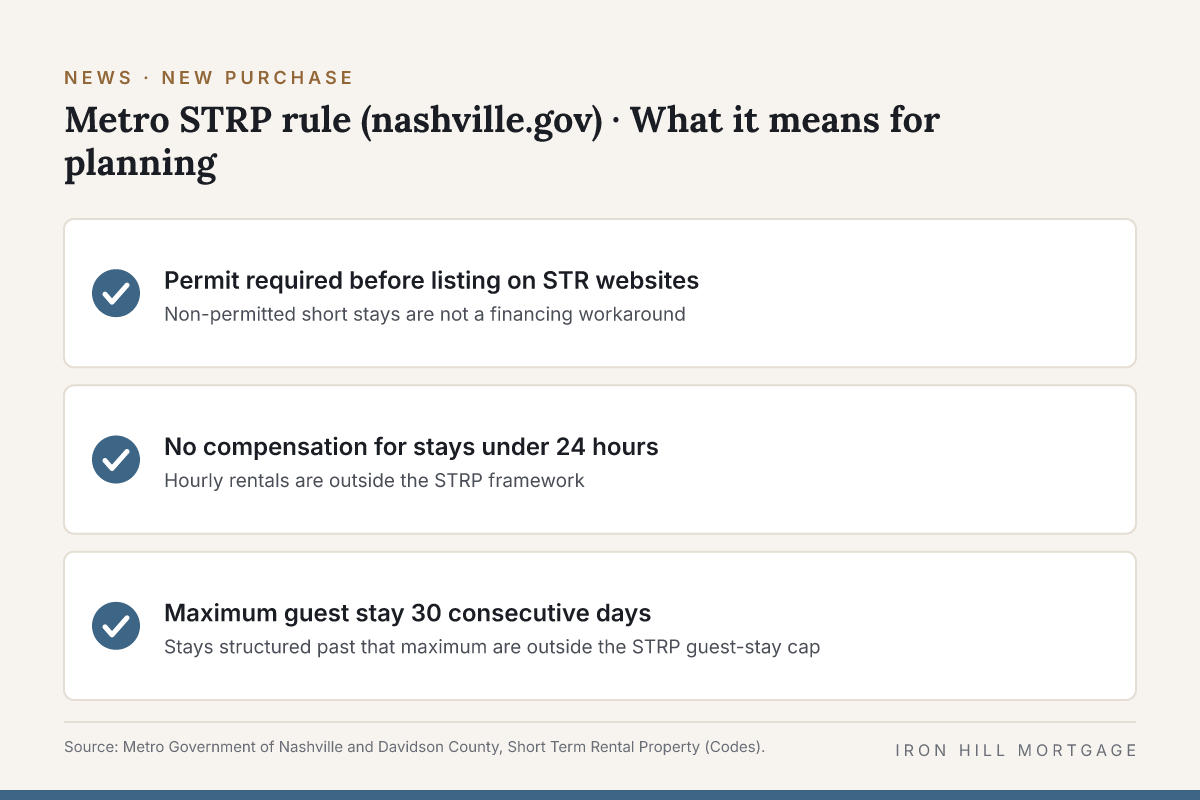
Metro Nashville's Short Term Rental Property page states that the law requires a permit from the Metro Codes Department before listing on short-term rental websites. It also states that a Short Term Rental Property owner shall not receive compensation for occupancy of less than 24 hours, and that the maximum stay for any guest shall be 30 consecutive days. Metro points readers to Metro Code §6.28.030 for the full short-term rental code.
| Metro STRP rule (nashville.gov) | What it means for planning |
|---|---|
| Permit required before listing on STR websites | Non-permitted short stays are not a financing workaround |
| No compensation for stays under 24 hours | Hourly rentals are outside the STRP framework |
| Maximum guest stay 30 consecutive days | Stays structured past that maximum are outside the STRP guest-stay cap |
Source: Metro Government of Nashville and Davidson County, Short Term Rental Property (Codes).
Investors should confirm current zoning and permit status for a specific address on nashville.gov rather than assume a furnished listing is automatically allowed. The Iron Hill Brief's guide to Nashville short-term rental permit rules covers the owner-occupied and non-owner-occupied permit landscape in more detail.
How lenders tend to view the income
Lender treatment of rental income is not the same as Metro's permit line. Fannie Mae's Selling Guide says rental income is an acceptable source of stable income if it is likely to continue, and it sets experience and documentation tests before positive rent can be used to qualify. For short-term rental income specifically, Fannie Mae publishes separate Selling Guide topics. Mid-term or longer furnished leases are not given a separate occupancy label in the general rental-income chapter, so investors should not assume any particular lease length will be treated as "standard" without asking the lender.
Business-purpose DSCR loans use their own rent and vacancy tests and are not Fannie Mae products. In every channel, underwriters care whether the income is documented, recurring and consistent with how the property is legally operated.
This article is not legal advice on whether a specific listing needs a Metro permit. It is a financing and compliance orientation for investors comparing short-term and mid-term strategies in Davidson County.
Working on a Tennessee rental? Talk with an Iron Hill loan advisor: text Ashley at 615-949-4780 or book a time here. Iron Hill Mortgage | NMLS #1946451.
Business-purpose loans for investment property only. Not for personal, family or household use. Subject to approval. Equal Housing Opportunity.
Sources
- Metro Government of Nashville and Davidson County, "Short Term Rental Property" (Codes; last updated Mar. 11, 2026; accessed Nov. 6, 2026): https://www.nashville.gov/departments/codes/short-term-rentals
- Fannie Mae Selling Guide, B3-3.8-01, "General Rental Income Information" (accessed Nov. 6, 2026): https://selling-guide.fanniemae.com/sel/b3-3.1-08/rental-income