
Are Mortgage Discount Points Worth It? Break-Even Math Explained
Are mortgage discount points worth it? How break-even math works, when buying down a rate pays off, and what Loan Estimates and Closing Disclosures show.
Whether mortgage discount points are worth it depends less on whether points exist than on how long the borrower keeps the loan after paying them. Discount points are an upfront fee that buys a lower interest rate; the Consumer Financial Protection Bureau says they can be a good choice for borrowers who plan to keep the loan a long time and have the cash at closing.
What discount points are
One point equals one percent of the loan amount, the CFPB explains. Points do not have to be whole numbers; a borrower can pay fractions of a point. Paying points lowers the interest rate compared with a zero-point loan of the same type from the same lender. Points appear on page 2, Section A of the Loan Estimate and Closing Disclosure, and by law those listed points must be connected to a discounted interest rate.
Lender credits work in reverse: a higher rate in exchange for money toward closing costs. The CFPB's example uses a $180,000 loan at 5.0% with zero points, then shows paying 0.375 points ($675) for a 4.875% rate and about $14 less each month, or taking a 5.125% rate for a $675 credit and about $14 more each month.
This Brief focuses on whether paying points is worth the upfront cost. The earlier Iron Hill Brief on how buying down a mortgage rate works covers what points are and how common they have become; this piece is the break-even decision.
How to run break-even math
The CFPB's Data Spotlight on discount points says most borrowers benefit from points only if they keep the mortgage long enough that cumulative monthly savings outweigh the upfront cost. That period is often called the break-even period and can be roughly estimated by dividing the cost of the points by the monthly payment savings.
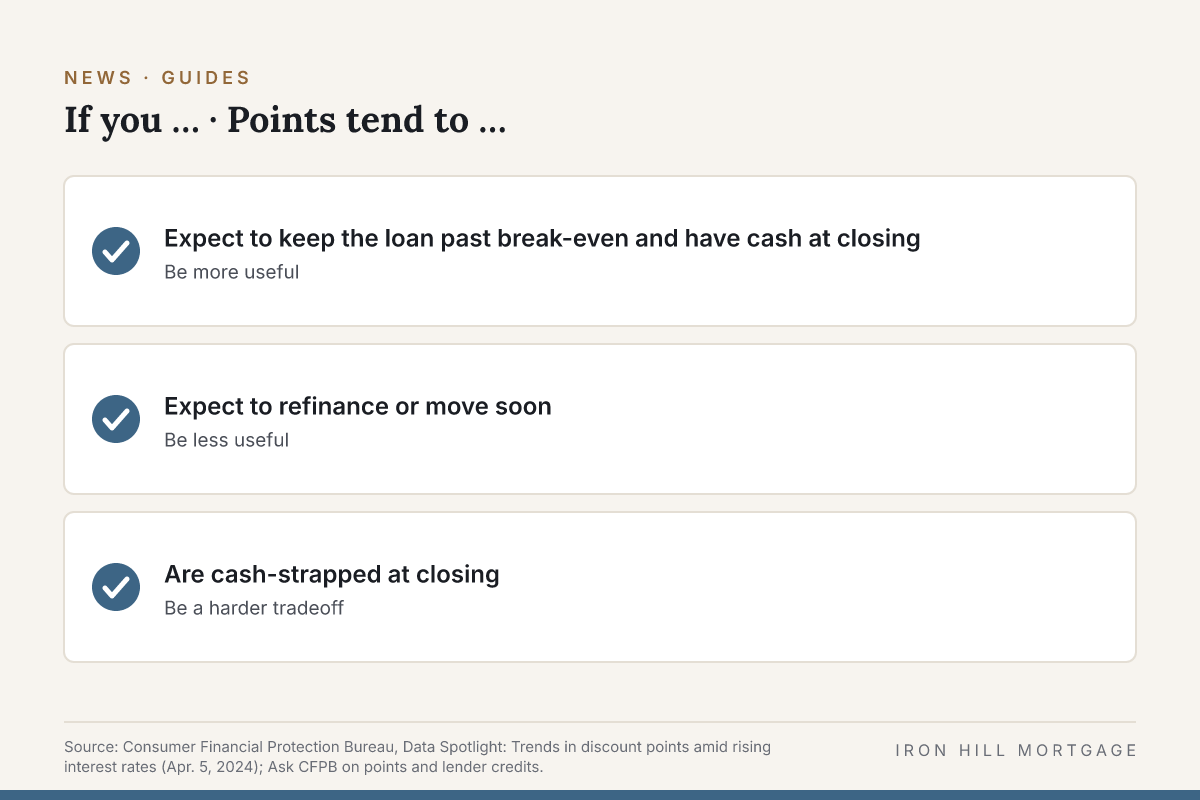
| If you … | Points tend to … |
|---|---|
| Expect to keep the loan past break-even and have cash at closing | Be more useful |
| Expect to refinance or move soon | Be less useful |
| Are cash-strapped at closing | Be a harder tradeoff |
Source: Consumer Financial Protection Bureau, Data Spotlight: Trends in discount points amid rising interest rates (Apr. 5, 2024); Ask CFPB on points and lender credits.
The spotlight also notes that points have no fixed value in rate terms: one point might buy a larger or smaller rate cut depending on the lender and the market. Comparing offers only on the quoted rate, without matching the points each lender builds in, can hide the true cost.
What to check on the Loan Estimate
Ask each lender for the same loan amount and the same points (or zero points) so the rates are comparable, the CFPB advises. Confirm that points on the Loan Estimate are listed in Section A and tied to the rate. The Iron Hill Brief's guide to how to read a Loan Estimate walks through that form line by line.
Frequently asked questions
How do I know if mortgage discount points are worth it for me? Estimate the break-even period (points cost divided by monthly savings) and compare it with how long you expect to keep the loan. The CFPB also suggests asking a loan officer to show total costs over short, likely and long holding periods.
Do points always lower the rate by a set amount? No. The CFPB's Data Spotlight says discount points have no fixed value in interest-rate terms; the rate reduction for one point varies by lender and market conditions.
Where do points show up on disclosures? On the Loan Estimate and Closing Disclosure, page 2, Section A, and they must be connected to a discounted interest rate.
Sources
- Consumer Financial Protection Bureau, "How should I use lender credits and points (also called discount points)?" (last reviewed Oct. 19, 2023; accessed Nov. 6, 2026): https://www.consumerfinance.gov/ask-cfpb/how-should-i-use-lender-credits-and-points-also-called-discount-points-en-136/
- Consumer Financial Protection Bureau, "Data Spotlight: Trends in discount points amid rising interest rates" (Apr. 5, 2024; accessed Nov. 6, 2026): https://www.consumerfinance.gov/data-research/research-reports/data-spotlight-trends-in-discount-points-amid-rising-interest-rates/