
How to Read a Loan Estimate: The Three-Page Form, Page by Page
How to read a Loan Estimate, the three-page form showing a lender's expected rate, payment and closing costs, and how to compare two offers side by side.
How to read a Loan Estimate is one of the most useful skills a mortgage shopper can have, because the three-page form is the clearest way to compare one loan offer with another. A lender must provide a Loan Estimate within three business days of receiving an application, according to the Consumer Financial Protection Bureau, and every lender uses the same standard form, so the same figures appear in the same places no matter who issues it.
The form lays out the estimated interest rate, the monthly payment, the total closing costs, estimated taxes and insurance, and how the rate and payment could change over time. A Loan Estimate is not an approval or a denial. The CFPB describes it as a statement of the terms the lender expects to offer if the borrower decides to move forward.
What do you need to get a Loan Estimate?
Lenders are required to provide a Loan Estimate once a borrower has supplied six pieces of information, the CFPB says: name, income, Social Security number, the property address, an estimate of the property's value and the desired loan amount. A lender cannot require more than that, such as a signed purchase agreement, before issuing the form, although sharing more detail generally makes the estimate more accurate.
How to read a Loan Estimate, page by page
Page 1 summarizes the loan. The CFPB's Loan Estimate explainer suggests checking that the borrower's name is spelled correctly, that the loan term, purpose, product and loan type match what was discussed, and, on a purchase, that the loan amount plus the down payment equals the sale price. This page shows the monthly principal and interest, the estimated total monthly payment including mortgage insurance and escrow where they apply, and whether the rate is locked and until when. It also flags features such as a prepayment penalty or a balloon payment, which are worth asking about.
Page 2 itemizes closing costs. Origination charges are the lender's upfront fees, and the CFPB notes that lenders itemize them differently, so "it's the total that matters." Services the borrower cannot shop for are chosen by the lender, while services the borrower can shop for come with a list of providers. The page also lists costs tied to owning the home, such as the homeowners insurance premium and property taxes, and calculates the estimated cash to close. An amount on the points line means the borrower is paying to lower the rate; the Iron Hill Brief's explainer on discount points covers that trade-off.
Page 3 lists the loan officer and a Comparisons section. Most loan officers must be licensed or registered with the Nationwide Mortgage Licensing System and Registry, which can be searched by name or NMLS ID, the CFPB says. The Comparisons section includes the annual percentage rate and the total interest percentage, which help borrowers compare the cost of one offer with another, along with the late-payment charge and whether the loan can be assumed by a future buyer.
How should you compare Loan Estimates from different lenders?
The CFPB suggests requesting Loan Estimates from three or more lenders for the same kind of loan so the comparison is like for like. Comparing the total origination charges, the services the borrower cannot shop for and the figures in the Comparisons section shows how offers differ. The Brief's guide to mortgage closing costs explains what individual fees cover.
Timing matters. A lender is required to honor the terms of a Loan Estimate for only 10 business days, and it cannot assume that silence means the borrower intends to proceed, according to the CFPB. A borrower who waits longer to say they want to move forward may receive a revised estimate.
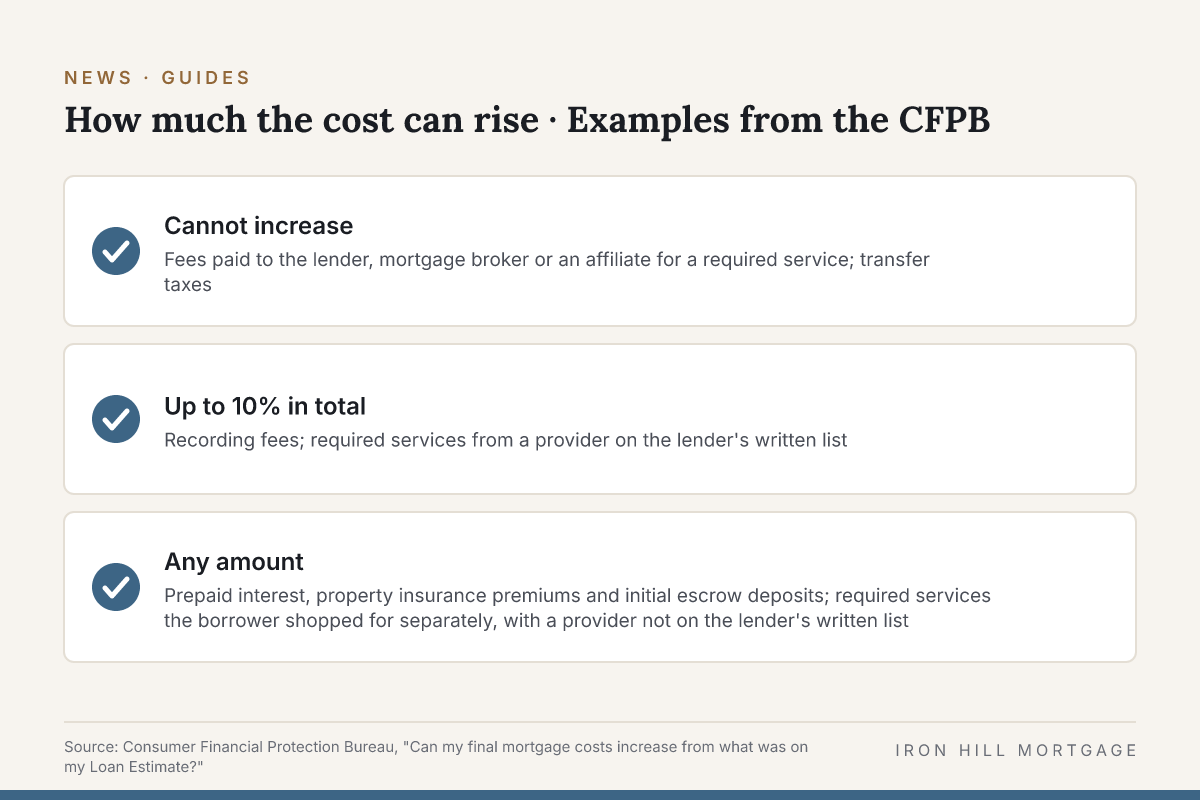
Not every figure is fixed. Federal rules summarized by the CFPB sort closing costs into three groups:
| How much the cost can rise | Examples from the CFPB |
|---|---|
| Cannot increase | Fees paid to the lender, mortgage broker or an affiliate for a required service; transfer taxes |
| Up to 10% in total | Recording fees; required services from a provider on the lender's written list |
| Any amount | Prepaid interest, property insurance premiums and initial escrow deposits; required services the borrower shopped for separately, with a provider not on the lender's written list |
Source: Consumer Financial Protection Bureau, "Can my final mortgage costs increase from what was on my Loan Estimate?"
Those limits do not apply after a change in circumstances, such as choosing a different kind of loan, changing the down payment or an appraisal that comes in higher or lower than expected. If costs rise beyond the allowed limits without such a change, the borrower is entitled to a refund of the excess, the CFPB says. Rate locks are covered in the Brief's guide to how a mortgage rate lock works.
Frequently asked questions
Is a Loan Estimate the same as a Closing Disclosure? No. The Loan Estimate arrives early in the process. The Closing Disclosure is a five-page form with the final loan terms and costs, and the lender must provide it at least three business days before closing so the borrower can compare it with the Loan Estimate, according to the CFPB. The Brief's explainer on the Closing Disclosure three-day rule covers that step.
Does getting a Loan Estimate commit me to that lender? No. The borrower decides whether to move forward. If the borrower does not tell the lender of an intent to proceed, the lender will most likely close out the application, the CFPB says.
Can the interest rate on my Loan Estimate change? Yes, if it is not locked. Even a locked rate can change if the application information changes or the loan does not close within the rate-lock timeframe, the CFPB says. Page 1 of the form shows whether the rate is locked and until when.
Sources
- Consumer Financial Protection Bureau, "What is a Loan Estimate?" (accessed Nov. 4, 2026): https://www.consumerfinance.gov/ask-cfpb/what-is-a-loan-estimate-en-1995/
- Consumer Financial Protection Bureau, "What information do I have to provide a lender in order to receive a Loan Estimate?" (accessed Nov. 4, 2026): https://www.consumerfinance.gov/ask-cfpb/what-information-do-i-have-to-provide-a-lender-in-order-to-receive-a-loan-estimate-en-1987/
- Consumer Financial Protection Bureau, Loan Estimate Explainer (accessed Nov. 4, 2026): https://www.consumerfinance.gov/owning-a-home/loan-estimate/
- Consumer Financial Protection Bureau, "My loan officer said that I need to express my 'Intent to Proceed'…" (accessed Nov. 4, 2026): https://www.consumerfinance.gov/ask-cfpb/my-loan-officer-said-that-i-need-to-express-my-intent-to-proceed-in-order-for-my-mortgage-loan-application-to-move-forward-what-does-that-mean-en-1989/
- Consumer Financial Protection Bureau, "Can my final mortgage costs increase from what was on my Loan Estimate?" (accessed Nov. 4, 2026): https://www.consumerfinance.gov/ask-cfpb/can-my-final-mortgage-costs-increase-from-what-was-on-my-loan-estimate-en-172/
- Consumer Financial Protection Bureau, "What is a Closing Disclosure?" (accessed Nov. 4, 2026): https://www.consumerfinance.gov/ask-cfpb/what-is-a-closing-disclosure-en-1983/