
Self-Employed Mortgage Income Documentation: What Lenders Review
Self-employed mortgage income documentation usually starts with two years of tax returns. What Fannie Mae asks lenders to verify, analyze and average.
Self-employed mortgage income documentation is how a lender shows that business income is stable enough to support a personal mortgage payment. Under Fannie Mae's Selling Guide, anyone with a 25% or greater ownership interest in a business is considered self-employed, and lenders must analyze both the borrower's personal income and, in many cases, the business itself.
Who counts as self-employed
Fannie Mae's topic on underwriting factors for a self-employed borrower says any individual who has a 25% or greater ownership interest in a business is considered self-employed. Before approving a loan, the lender must analyze the stability of the borrower's income, the location and nature of the business, demand for its product or service, the financial strength of the business, and the ability of the business to keep distributing enough income for the borrower to make the mortgage payment.
Documents lenders typically collect
Fannie Mae generally requires a two-year history of prior earnings as a way to show the income is likely to continue. Lenders may verify employment and income with signed federal income tax returns filed with the IRS for the past two years — individual returns and, in some cases, business returns — with all applicable schedules, or with complete IRS-issued transcripts for those years.
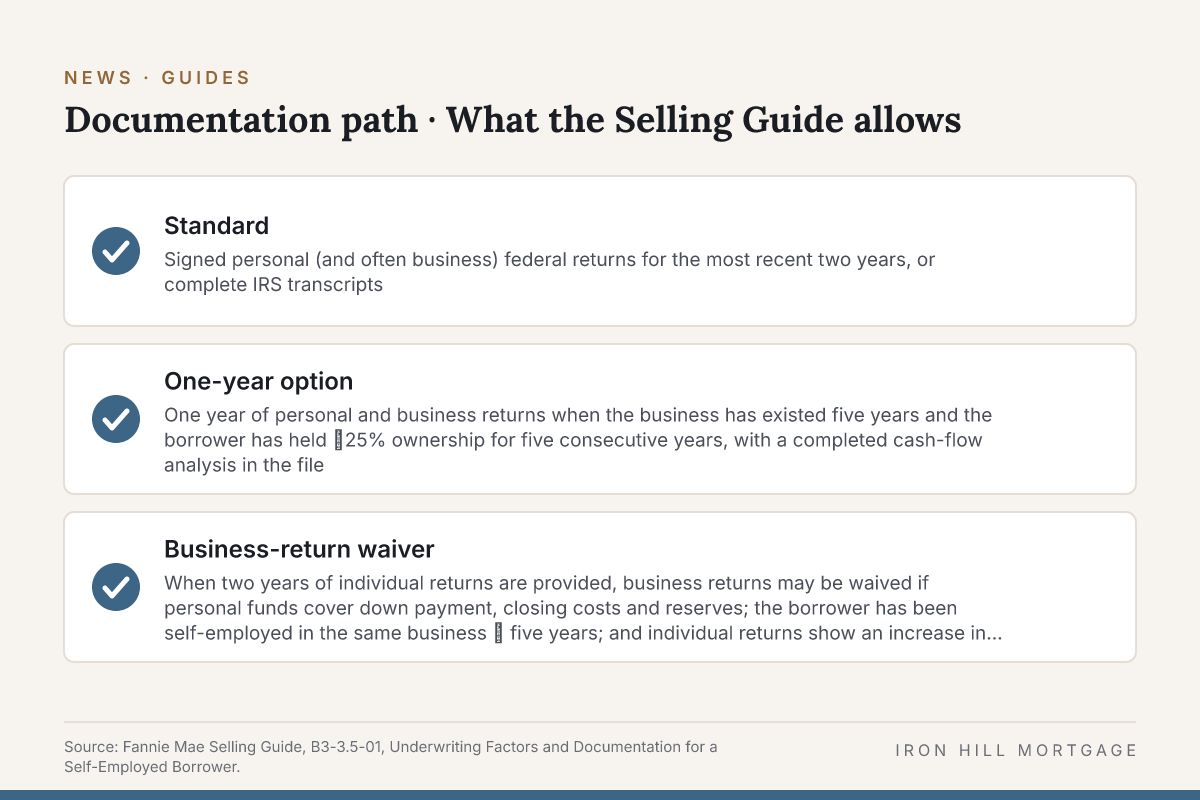
| Documentation path | What the Selling Guide allows |
|---|---|
| Standard | Signed personal (and often business) federal returns for the most recent two years, or complete IRS transcripts |
| One-year option | One year of personal and business returns when the business has existed five years and the borrower has held ≥25% ownership for five consecutive years, with a completed cash-flow analysis in the file |
| Business-return waiver | When two years of individual returns are provided, business returns may be waived if personal funds cover down payment, closing costs and reserves; the borrower has been self-employed in the same business ≥ five years; and individual returns show an increase in self-employment income over the past two years |
Source: Fannie Mae Selling Guide, B3-3.5-01, Underwriting Factors and Documentation for a Self-Employed Borrower.
Borrowers with less than a two-year self-employment history may still be considered if the most recent signed personal and business returns reflect a full 12 months from the current business and the file documents prior income at the same or greater level in a related field or role.
How underwriters turn returns into qualifying income
Business income reported on a Form 1040 does not automatically equal cash available to the borrower. The Selling Guide says the core exercise is a cash-flow analysis: determine income that can be relied on for the personal mortgage while keeping the business viable. Lenders must prepare a written evaluation of personal income (and of business income when business returns are required), and they may use Fannie Mae's Cash Flow Analysis Form 1084, Comparative Income Analysis Form 1088, Income Calculator or another method that applies the same principles.
If the borrower also wants to use business assets for down payment, closing costs or reserves while qualifying on self-employment income, the lender must confirm that withdrawing those funds will not harm the business.
Frequently asked questions
Do self-employed borrowers always need two years of tax returns? Usually yes under Fannie Mae, but the Selling Guide allows a one-year path when the five-year business and ownership tests are met and a cash-flow analysis is completed.
Does Schedule C profit equal qualifying income? Not automatically. Lenders run a cash-flow analysis because reported taxable income may not reflect cash available to the borrower.
How does this interact with debt-to-income ratio? Qualifying income from the analysis feeds the same debt-to-income framework used for W-2 borrowers. The Iron Hill Brief's guides to debt-to-income ratio and credit score needed for a mortgage cover those pieces of the file.
Sources
- Fannie Mae Selling Guide, B3-3.5-01, "Underwriting Factors and Documentation for a Self-Employed Borrower" (Dec. 13, 2023 version; accessed Nov. 6, 2026): https://selling-guide.fanniemae.com/sel/b3-3.2-01/underwriting-factors-and-documentation-self-employed-borrower