
Gift Letter Mortgage Rules: What the Letter Must Say and Who Can Give
Gift letter mortgage rules under Fannie Mae: who can give money toward a down payment, what the signed letter must include and how lenders trace the funds.
A gift letter is the signed statement a mortgage lender asks for when a relative or other approved donor gives a buyer money toward a home, and gift letter mortgage rules for conventional loans come from Fannie Mae's Selling Guide. The letter confirms the money is a gift, not a loan, and the lender then has to verify that the funds are in the donor's account or have been transferred to the buyer or the closing agent.
What a gift letter for a mortgage must include
Under Fannie Mae's rules, the gift letter must be signed by the donor and must:
- State the actual dollar amount of the gift, or the maximum amount
- Include the donor's statement that no repayment is expected
- List the donor's name, address, telephone number and relationship to the borrower
If the gift comes from a trust or estate set up by an acceptable donor, the letter must be signed by the donor and name the trust or estate account.
Gift letter mortgage rules on who can give
Fannie Mae allows gifts from a relative, defined as the borrower's spouse, child or other dependent, or anyone related by blood, marriage, adoption or legal guardianship. It also allows gifts from a non-relative with a familial relationship, such as a domestic partner, a fiancé or fiancée, a former relative, or someone with a long-standing familial-like or mentorship relationship with the borrower.
The donor cannot be, or be affiliated with, the builder, developer, real estate agent or any other interested party to the sale. Gifts are allowed for a principal residence or second home, but not for an investment property.
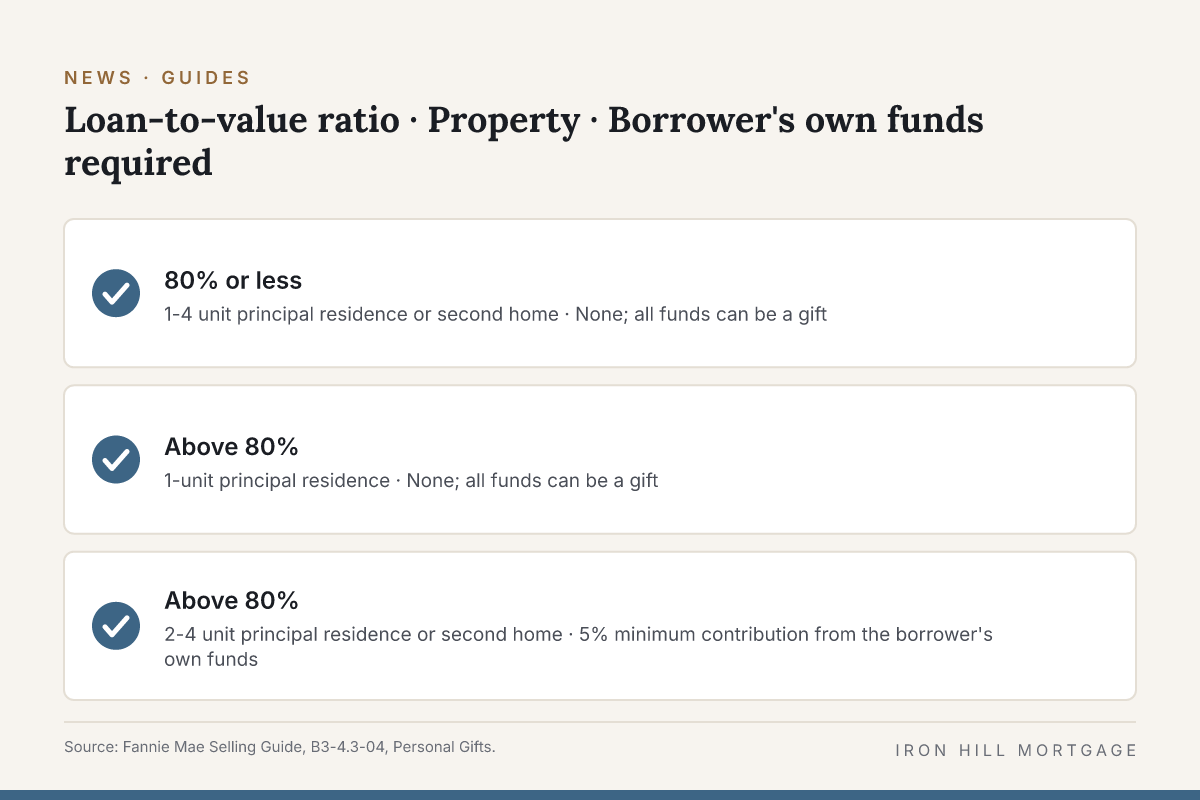
How much of your own money you need
| Loan-to-value ratio | Property | Borrower's own funds required |
|---|---|---|
| 80% or less | 1-4 unit principal residence or second home | None; all funds can be a gift |
| Above 80% | 1-unit principal residence | None; all funds can be a gift |
| Above 80% | 2-4 unit principal residence or second home | 5% minimum contribution from the borrower's own funds |
Source: Fannie Mae Selling Guide, B3-4.3-04, Personal Gifts.
Once any required minimum contribution is met, gift money can also cover closing costs and reserves.
How lenders verify gift money
The lender must confirm the money is either in the donor's account or has already moved to the borrower. Acceptable records include a copy of the donor's check and the borrower's deposit slip, a withdrawal slip paired with a deposit slip, evidence of an electronic transfer to the borrower or the closing agent, or a settlement statement showing receipt of the donor's check. If the money is not transferred before closing, the donor has to give it to the closing agent by electronic transfer or a certified, cashier's or other official check.
Gift rules sit alongside the rest of the approval. The Iron Hill Brief's guide to preapproval vs. prequalification explains the difference between those two early steps, the home affordability calculator can help set a price range, and the guide to the Closing Disclosure three-day rule covers the final numbers before closing.
Frequently asked questions
Can a gift cover my whole down payment? On a one-unit principal residence, Fannie Mae does not require a minimum contribution from the borrower's own funds, so a gift from an acceptable donor can cover all of it. On a two- to four-unit home or a second home with a loan-to-value ratio above 80%, the borrower must put in at least 5% from their own funds.
Can a friend give me money for a down payment? Only if the friend fits Fannie Mae's definition of an acceptable donor, such as someone with a long-standing familial-like or mentorship relationship with the borrower. The donor cannot be tied to the builder, agent or another party to the sale.
Does a mortgage gift have tax consequences? The IRS annual gift tax exclusion is $19,000 per recipient for gifts made in 2026. Donors giving more than that should ask a tax professional about federal gift tax reporting; this article is not tax advice.
Sources
- Fannie Mae Selling Guide, B3-4.3-04, "Personal Gifts" (02/04/2026; accessed Oct. 30, 2026): https://selling-guide.fanniemae.com/sel/b3-4.3-04/personal-gifts
- Internal Revenue Service, "What's new — Estate and gift tax" (accessed Oct. 30, 2026): https://www.irs.gov/businesses/small-businesses-self-employed/whats-new-estate-and-gift-tax