
Mortgage Recast vs. Refinance: Lowering a Payment With or Without a New Loan
Mortgage recast vs. refinance: a recast re-spreads a lower balance over the same rate and term, while a refinance replaces the loan. How to compare them.
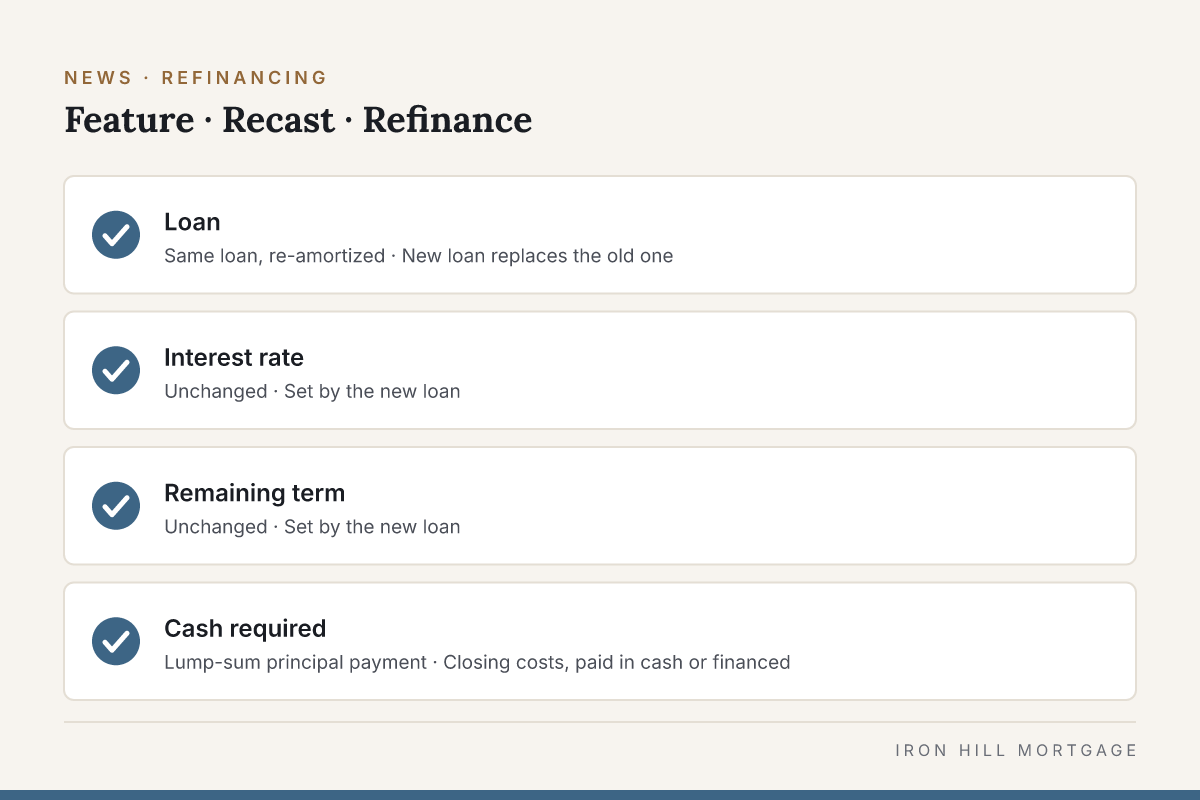
Mortgage recast vs. refinance is a choice between two ways to lower a monthly payment: a recast keeps the existing loan and re-spreads a smaller balance over the time that remains, while a refinance replaces the loan with a new one. Which one fits depends on whether the goal is a lower payment on the same terms or a different rate or term altogether.
What is a mortgage recast?
A recast, also called a re-amortization, follows a large extra payment toward principal. Fannie Mae's Servicing Guide says servicers must accept and apply an additional principal payment that a borrower identifies as such on a current loan. After a substantial principal payment, the borrower can ask that the loan be re-amortized to reduce the contractual monthly payment, and the servicer may agree to recalculate principal and interest on the lower balance using the current interest rate and the remaining loan term.
Because the rate and the payoff date stay the same, the main result of a recast is a smaller required payment. The servicer documents the change on Fannie Mae's re-amortization agreement form, and the Servicing Guide says a re-amortization is not treated as a loan modification for purposes of later modification eligibility. Whether a recast is offered is up to the loan's investor and servicer, so borrowers generally start by asking their servicer.
Mortgage recast vs. refinance: how they compare
| Feature | Recast | Refinance |
|---|---|---|
| Loan | Same loan, re-amortized | New loan replaces the old one |
| Interest rate | Unchanged | Set by the new loan |
| Remaining term | Unchanged | Set by the new loan |
| Cash required | Lump-sum principal payment | Closing costs, paid in cash or financed |
| Application | Request to the servicer | New application, underwriting and closing |
Sources: Fannie Mae Servicing Guide, C-1.2-01; Consumer Financial Protection Bureau.
A refinance involves closing costs. The Consumer Financial Protection Bureau lists common charges such as appraisal fees, title insurance, government taxes and prepaid expenses, and notes that a lender credit toward costs is typically paid for through a larger loan amount or a higher interest rate.
When a refinance may still win
A recast cannot change the interest rate, switch an adjustable-rate loan to a fixed rate, or shorten or extend the term. A refinance can do those things, which is why it is often the tool when market rates have moved or the loan's structure no longer fits. The Iron Hill Brief's explainer on the rate-and-term refinance covers that route in more detail.
The tradeoff is cost. A refinance makes sense on payment savings alone only if the borrower expects to keep the new loan past the point where monthly savings have repaid the closing costs. Iron Hill's refinance break-even calculator estimates that point from a borrower's own numbers.
Frequently asked questions
Does a recast lower the interest rate? No. A recast keeps the existing rate and remaining term; only the balance, and therefore the required principal and interest payment, changes.
Can any mortgage be recast? Not always. Availability depends on the loan's investor and servicer, and the loan generally must be current under the Servicing Guide. Borrowers can confirm eligibility with their servicer before sending a lump sum.
Does a recast require a new application? A recast is handled by the existing servicer through a re-amortization agreement rather than a new loan application, according to Fannie Mae's Servicing Guide.
Sources
- Fannie Mae Servicing Guide, C-1.2-01, "Processing Additional Principal Payments" (accessed Nov. 5, 2026): https://guide-servicing.fanniemae.com/svc/c-1.2-01/processing-additional-principal-payments
- Consumer Financial Protection Bureau, "What fees or charges are paid when closing on a mortgage and who pays them?" (accessed Nov. 5, 2026): https://www.consumerfinance.gov/ask-cfpb/what-fees-or-charges-are-paid-when-closing-on-a-mortgage-and-who-pays-them-en-1845/