
New Construction vs. Resale Homes in Nashville: What Buyers Should Compare
New construction vs. resale homes in Nashville: how inspections, rate locks, builder contracts and financing differ for Middle Tennessee buyers today.
New construction vs. resale homes in Nashville is a choice between a builder's timeline and an existing house that can usually close on a shorter schedule. Financing rules are largely the same conventional or government loan products in either case, but inspections, rate locks and contract terms often diverge in ways that matter before a buyer writes an offer.
Inspections on new builds and existing homes
The Consumer Financial Protection Bureau advises buyers to schedule an independent home inspection as soon as possible after choosing a home, and to treat the inspection as different from the lender's appraisal. A purchase contract that is contingent on a satisfactory inspection generally lets a buyer cancel without penalty if the results are unsatisfactory, the CFPB says.
On a resale, that inspection is often the buyer's main look at systems, structure and deferred maintenance. On new construction, buyers still commonly hire their own inspector at key stages or before closing, even when the builder provides a warranty and municipal inspections. Builder contracts may limit when and how a buyer can walk away; those terms are contract questions for a real estate attorney, not a loan product feature.
The Iron Hill Brief's guide to the home inspection contingency covers how that clause works in a typical purchase contract.
Rate locks and longer timelines
A rate lock means the interest rate will not change between the offer and closing if the borrower closes within the lock period and the application does not change, according to the CFPB. Locks commonly run 30, 45 or 60 days, and sometimes longer. Extending a lock can be expensive, and a lock can also keep a borrower from a lower rate if rates fall.
New-construction closings often sit further out than resale closings, which makes lock length and extension costs a larger planning item. The CFPB notes that a locked rate can still change if the application changes — for example, loan amount, credit score, verified income or an appraisal that differs from expectations. Check page 1 of the Loan Estimate for whether the rate is locked and for how long. The Brief's explainer on how a mortgage rate lock works goes deeper on those mechanics.
Contract and financing differences to compare
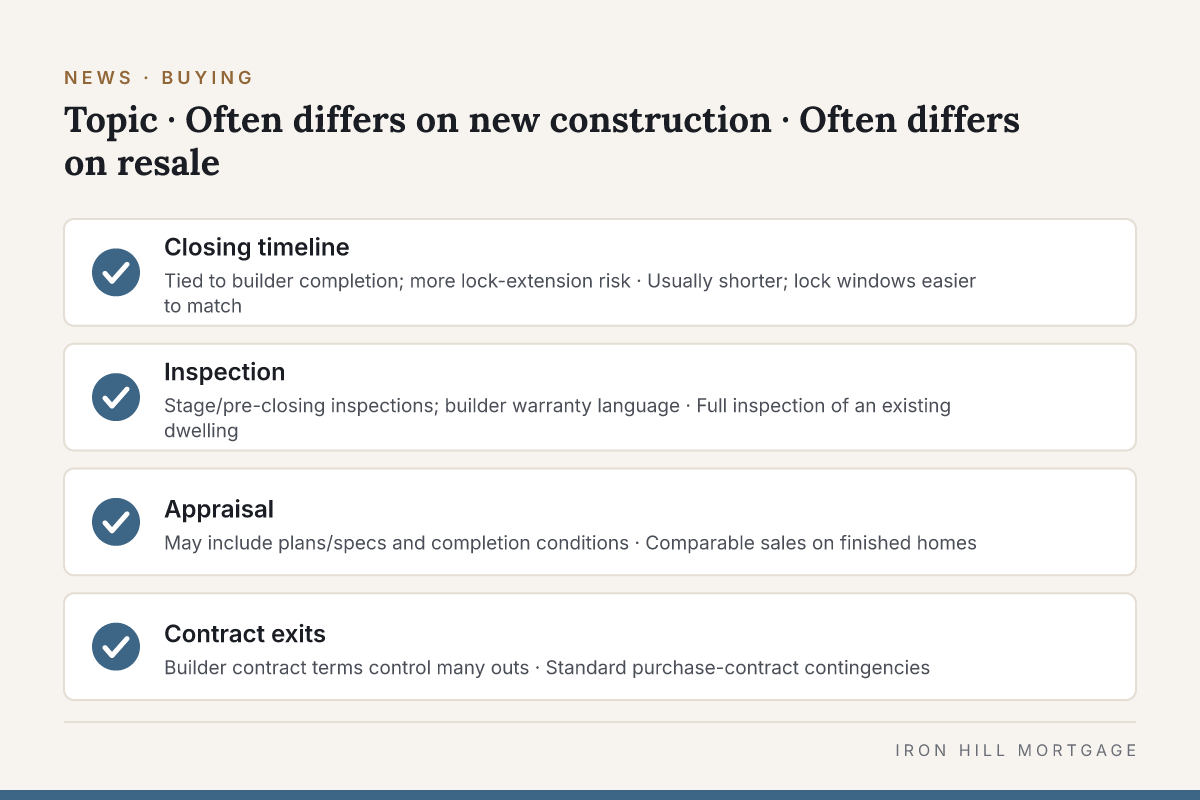
| Topic | Often differs on new construction | Often differs on resale |
|---|---|---|
| Closing timeline | Tied to builder completion; more lock-extension risk | Usually shorter; lock windows easier to match |
| Inspection | Stage/pre-closing inspections; builder warranty language | Full inspection of an existing dwelling |
| Appraisal | May include plans/specs and completion conditions | Comparable sales on finished homes |
| Contract exits | Builder contract terms control many outs | Standard purchase-contract contingencies |
Sources: Consumer Financial Protection Bureau (rate lock; home inspection).
Neither path is automatically easier to finance. Both still require underwriting, an appraisal the lender can rely on, and clear title. Buyers comparing the two should line up the contract timeline with a realistic rate-lock period before they stop shopping.
Sources
- Consumer Financial Protection Bureau, "What's a lock-in or a rate lock on a mortgage?" (last reviewed May 2, 2023; accessed Nov. 6, 2026): https://www.consumerfinance.gov/ask-cfpb/whats-a-lock-in-or-a-rate-lock-en-143/
- Consumer Financial Protection Bureau, "Schedule a home inspection" (accessed Nov. 6, 2026): https://www.consumerfinance.gov/owning-a-home/close/schedule-a-home-inspection/