
Tennessee Transfer Tax: State Rates, Who Pays and the Loan Estimate
Tennessee transfer tax is $0.37 per $100 of a home's price or value, plus a mortgage tax on the loan. The state rates, who pays and where they show up.
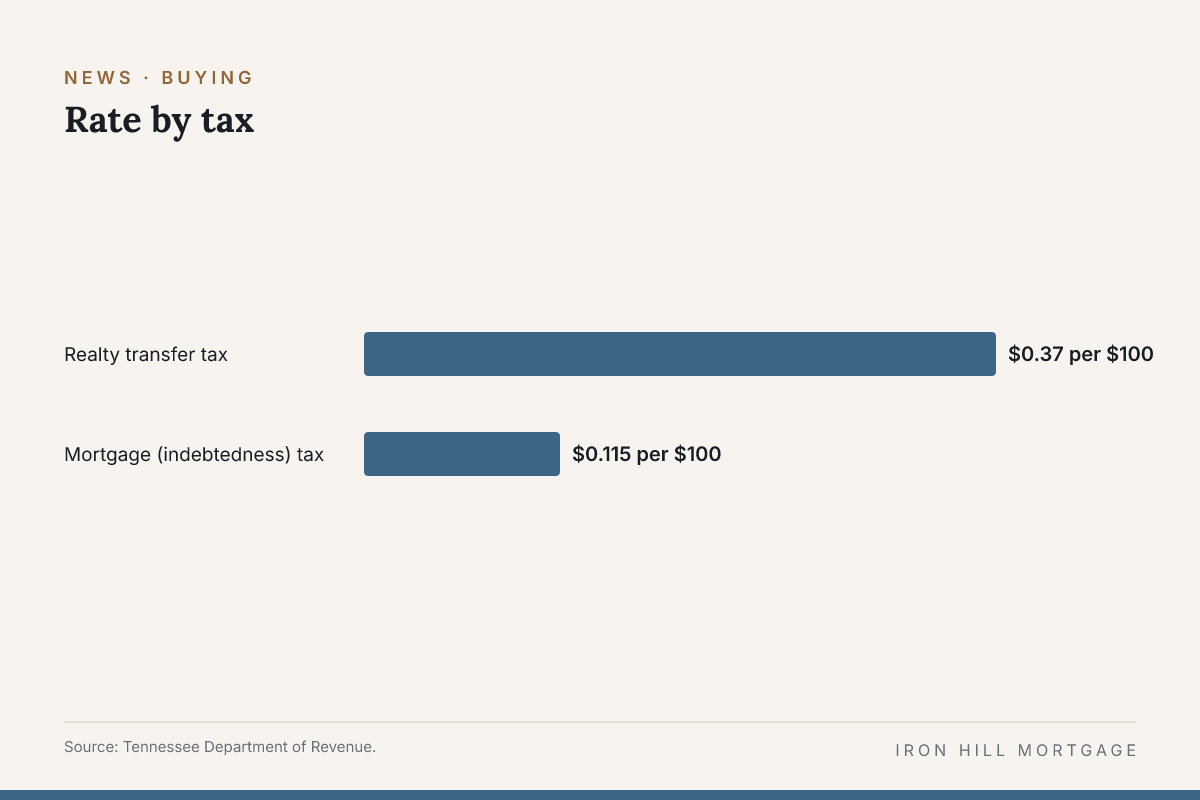
Tennessee transfer tax is a state tax charged when a deed is recorded, and it shows up on almost every home purchase in the state, along with a separate tax on recording the mortgage. Both rates are set in state law, Tenn. Code Ann. § 67-4-409, so they are the same in every county.
The Iron Hill Brief's explainer on what mortgage closing costs really include covers closing costs in general. This piece covers the two Tennessee recording taxes: the rates, what each is based on, who the state says pays, and where they appear on a Loan Estimate.
What is the Tennessee transfer tax rate?
The Tennessee Department of Revenue lists the realty transfer tax at $0.37 per $100. Its Recordation Tax Manual says the tax is generally based on the greater of the consideration paid or the value of the property at the time of transfer. On a typical sale, that is usually the purchase price.
The second tax is on the loan. The department lists the mortgage tax, which its manual calls the indebtedness tax, at $0.115 per $100 of indebtedness, and the first $2,000 of the debt is exempt. It is charged when a mortgage or deed of trust is recorded, and it is based on the principal, not on interest.
| Tax | Rate | Based on |
|---|---|---|
| Realty transfer tax | $0.37 per $100 | Greater of the price paid or the property's value |
| Mortgage (indebtedness) tax | $0.115 per $100 | Principal debt, minus the first $2,000 |
Source: Tennessee Department of Revenue.
As an illustration only, on a $450,000 purchase with a $405,000 loan, the transfer tax would be $1,665 ($450,000 ÷ 100 × $0.37). The mortgage tax would be $463.45 (($405,000 − $2,000) ÷ 100 × $0.115). Together that is $2,128.45. Those figures leave out county recording fees, title charges and every other closing cost, and they are arithmetic on the illustration, not a quote.
Who pays the transfer tax in Tennessee?
The Department of Revenue's manual answers that directly. For the realty transfer tax, the grantee or transferee named on the deed, which on a sale is the buyer, is responsible for paying it. For the indebtedness tax, the mortgagor, grantor or debtor on the recorded instrument pays, and the holder of the debt must collect and remit it. On a purchase loan, that means the borrower.
Both taxes are collected by the register of deeds in the county where the document is recorded, and the manual says the register may not record a transfer until the tax is paid. In practice, the closing agent collects the money at closing and pays it when the documents are recorded.
The mortgage tax is not limited to purchases. Because it attaches to recording a debt instrument, the manual notes that when an existing recorded debt is increased, additional tax is due on the increase.
Where do these taxes show on the Loan Estimate?
The Loan Estimate lists them under Other Costs, in the section titled Taxes and Other Government Fees. The Consumer Financial Protection Bureau's official interpretation of Regulation Z separates two lines there. Transfer taxes are state and local fees on mortgages and home sales that are based on the loan amount or sales price. Recording fees are flat or per-page charges for recording documents.
Under that definition, both Tennessee taxes are based on a price or a loan amount, so they generally belong on the transfer taxes line, not with recording fees. The CFPB also says only the transfer taxes the consumer pays are disclosed on the Loan Estimate, and that state or local law decides whether the seller or the consumer is responsible. The Brief's guide on how to read a Loan Estimate walks through the rest of the form.
Frequently asked questions
How much is the transfer tax on a house in Tennessee?
The state rate is $0.37 per $100 of the greater of the price or the property's value, which works out to $370 for every $100,000.
Is the Tennessee mortgage tax the same as the transfer tax?
No. The transfer tax is on the deed. The mortgage, or indebtedness, tax is $0.115 per $100 of the loan, after the first $2,000, and is charged when the mortgage or deed of trust is recorded.
Does the rate differ by county?
No. Both rates are set in state law. County registers of deeds collect the taxes, and they also charge their own recording fees.
Sources
- Tennessee Department of Revenue, Recordation Taxes: Due Date and Tax Rates (accessed Nov. 18, 2026): https://www.tn.gov/revenue/taxes/local-taxes/recordation-taxes/due-date-tax-rate.html
- Tennessee Department of Revenue, Recordation Tax Manual, June 2026 (accessed Nov. 18, 2026): https://www.tn.gov/content/dam/tn/revenue/documents/tax_manuals/june-2026/recordation-tax.pdf
- Consumer Financial Protection Bureau, Regulation Z, 12 CFR 1026.37(g)(1) and official interpretation (accessed Nov. 18, 2026): https://www.consumerfinance.gov/rules-policy/regulations/1026/37/