
Tennessee Rental Property Tax Assessment: 25% vs. 40% Explained
Tennessee rental property tax assessment depends on use: a single rental is usually assessed at 25% of value, a building with two or more rentals at 40%.
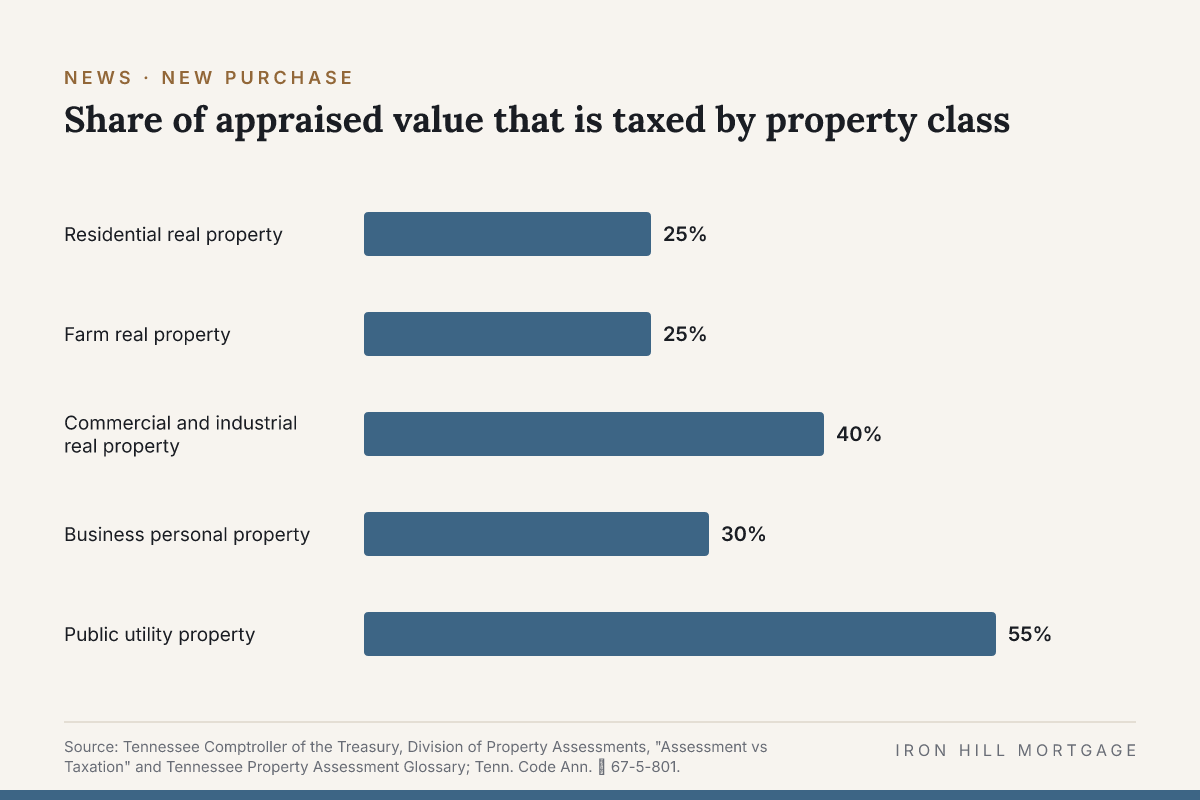
Tennessee rental property tax assessment starts with a question of use: the state taxes real estate at different fractions of its value depending on how the property is classified, and for rental investors that classification can make a large difference in the bill. A single-family rental is generally treated as residential property, while a building with two or more rental units falls into the commercial class, according to the Tennessee Comptroller of the Treasury.
How Tennessee rental property tax assessment works
The Comptroller's Division of Property Assessments describes four parts to every Tennessee property tax bill. The county assessor of property sets the appraised value, an estimate of what the property would most probably sell for. State law then sets an assessment ratio for each class of property. Multiplying the appraised value by that ratio produces the assessed value, and the local tax rate, set by the county commission and, inside city limits, by the city, is applied to the assessed value.
| Property class | Share of appraised value that is taxed |
|---|---|
| Residential real property | 25% |
| Farm real property | 25% |
| Commercial and industrial real property | 40% |
| Business personal property | 30% |
| Public utility property | 55% |
Source: Tennessee Comptroller of the Treasury, Division of Property Assessments, "Assessment vs Taxation" and Tennessee Property Assessment Glossary; Tenn. Code Ann. § 67-5-801.
The Comptroller's own example uses a house appraised at $400,000. At the 25% residential ratio, the assessed value is $100,000. With a county tax rate of $2.50 per $100 of assessed value, the tax is $2,500. Actual rates vary by county and city.
When a rental is assessed at 25% or 40%
Classification in Tennessee is based on how a property is currently used. The Comptroller's glossary says all real property used for dwelling purposes that contains two or more rental units is classified as industrial and commercial property and assessed at 40% of its appraised value. A rental house with a single unit is generally classified as residential and assessed at 25%.
That means a duplex, triplex or small apartment building held as a rental is typically assessed at a higher share of its value than a single-family rental of the same appraised value. State law also addresses short-term rentals: under Tenn. Code Ann. § 67-5-801, when a property is the owner's principal residence, contains no more than one rental unit and is used as a short-term rental, the assessor should presume a residential classification. Investors with questions about how a specific parcel is classified can ask the county assessor of property.
Key dates and reappraisal
Several dates in the Comptroller's assessment schedule matter to owners:
- January 1 is the assessment date; ownership records and assessments reflect the status of the property on that day.
- Change notices are generally mailed by May 20 when a value or classification changes.
- County boards of equalization, which hear local appeals, meet beginning June 1 (Shelby County convenes May 1).
- Taxes become due on the first Monday in October, and the last day to pay them without interest is Feb. 28 of the following year.
Tennessee counties also reappraise property on four-, five- or six-year cycles, according to the Comptroller. Between reappraisals, a property's appraisal generally stays the same unless it changes significantly, for example through new construction or demolition. In a reappraisal year, the state's certified tax rate law requires local governments to calculate a tax-neutral rate and hold public hearings before adopting a rate that would raise more total revenue than the prior year.
For investors, the assessment class feeds directly into the property tax line of a rental's operating budget, which lenders consider when reviewing rental income. The Iron Hill Brief's guide to DSCR loans in Tennessee explains how lenders compare rent with the full monthly payment, including taxes, and the overview of DSCR loans covers rental-income financing. Depreciation, a separate federal tax matter, is covered in the Brief's rental property depreciation guide.
Frequently asked questions
Is a single-family rental in Tennessee taxed like a home? Generally, yes. A dwelling with one rental unit is typically classified as residential property and assessed at 25% of its appraised value, the same ratio as an owner-occupied house. Tennessee's property tax relief and freeze programs have their own eligibility rules.
Why is a duplex taxed at a higher rate? The tax rate is the same; the assessment ratio differs. Dwelling property with two or more rental units is classified as commercial, so 40% of its appraised value is taxed instead of 25%, according to the Comptroller.
Who sets the tax rate? County commissions, and city governing bodies inside city limits, set local tax rates. The county assessor of property appraises and classifies property, and the county trustee collects the tax.
Working on a Tennessee rental? Talk with an Iron Hill loan advisor: text Ashley at 615-949-4780 or book a time here. Iron Hill Mortgage | NMLS #1946451.
Business-purpose loans for investment property only. Not for personal, family or household use. Subject to approval. Equal Housing Opportunity.
Sources
- Tennessee Comptroller of the Treasury, "How to Calculate Your Tax Bill" (accessed Nov. 4, 2026): https://comptroller.tn.gov/office-functions/pa/property-taxes/how-to-figure-your-tax-bill.html
- Tennessee Comptroller of the Treasury, "Assessment vs Taxation" (accessed Nov. 4, 2026): https://comptroller.tn.gov/office-functions/pa/property-taxes/assessment-vs-taxation.html
- Tennessee Comptroller of the Treasury, "Assessment Schedule" (accessed Nov. 4, 2026): https://comptroller.tn.gov/office-functions/pa/property-taxes/assessment-schedule.html
- Tennessee Comptroller of the Treasury, Division of Property Assessments, "Defining Tennessee Property Assessments: A Glossary of Property Assessment Terms," Volume I, 2018 (accessed Nov. 4, 2026): https://comptroller.tn.gov/content/dam/cot/pa/documents/pa/Tennessee_Property_Assessment_Glossary.pdf
- Tenn. Code Ann. § 67-5-801, Classification and rate of assessment (2025 Tennessee Code via Justia, accessed Nov. 4, 2026): https://law.justia.com/codes/tennessee/title-67/chapter-5/part-8/section-67-5-801/